

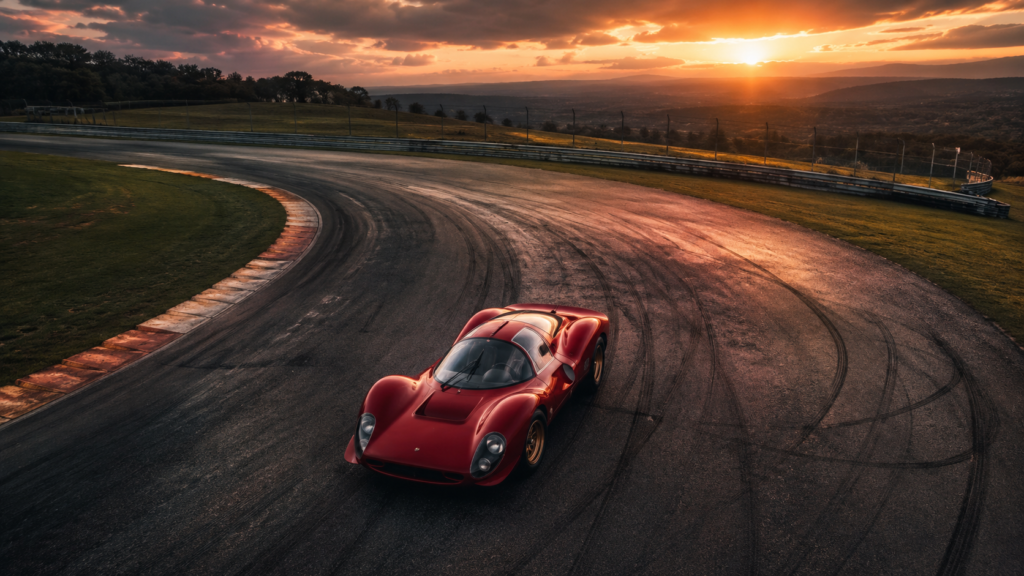
The sun is dipping behind the hills of Seneca Lake, casting long shadows across the historic Watkins Glen International circuit in upstate New York. The Boot, that twisting, unforgiving section of the track, is quiet now. But in the evening light, a red shape seems to flicker at the edge of vision. It is the ghost of a Ferrari 330 P4, the car that gave Enzo Ferrari one of his greatest victories.
The 330 P4 is not merely a car. It is a piece of racing history, a masterpiece of 1960s engineering, and a work of art. With styling similar to the 330 P3, this model was powered by a V12 engine radically redesigned by Franco Rocchi. The most obvious modification was the introduction of a three-valve cylinder head with two inlet valves and one exhaust valve. Fuel feed was provided by a Lucas injection system. The chassis was slightly shorter than the 330 P3’s, and the new suspension system improved roadholding.
The car won numerous races and earned its place in the history books after a memorable 1-2-3 finish at the 1967 Daytona 24 Hours. This article tells the story of that car, its engineering, and its lasting legacy.
The Location: Watkins Glen International, New York
Watkins Glen is a cathedral of American road racing. The original circuit ran through public roads. The modern track, with its high speed esses and the demanding Boot section, has hosted everything from Formula 1 to NASCAR. It is a fitting place to remember a car that dominated on both sides of the Atlantic.
The 330 P4 never raced at Watkins Glen in period, but the spirit of the car echoes through the facility. The track rewards the same qualities that made the P4 great: balance, power, and bravery.
The Genesis: Replacing the 330 P3
The 330 P4 was born from necessity. Ferrari needed to respond to the Ford GT40, which had embarrassed the Italian manufacturer at Le Mans in 1966. The P3 had been a good car, but it was not good enough. Enzo Ferrari wanted something better.
The P4 was not a clean sheet design. It evolved from the P3. The chassis was slightly shorter, improving agility. The suspension was revised, with new geometry that improved roadholding through high speed corners. But the real changes were under the engine cover.
The Engine: Franco Rocchi’s Masterpiece
The heart of the 330 P4 was its V12 engine. Displacing 3,967.44 cc, it was a development of the P3’s unit. But the changes were significant.
Franco Rocchi, one of Ferrari’s most talented engineers, redesigned the cylinder heads. The new design used three valves per cylinder, two for intake and one for exhaust. This was a departure from the two valve layout common at the time. The three valve head allowed for better airflow, improving power and response.
The engine also received Lucas fuel injection, replacing the earlier Weber carburetors. Fuel injection provided more precise metering, better throttle response, and increased power. The result was 331 kilowatts, or approximately 450 horsepower, at 8,000 rpm. The top speed was 320 kilometers per hour, or 199 miles per hour.
The engine was mounted amidships, behind the driver. This layout provided excellent weight distribution and handling balance.
The 1967 Daytona 24 Hours: The 1-2-3 Victory
The 330 P4’s defining moment came at the 1967 Daytona 24 Hours. The race was held on the high banks of the Daytona International Speedway, a track that demanded power, courage, and reliability.
Ferrari entered three 330 P4s. The drivers were some of the best in the world: Lorenzo Bandini, Chris Amon, Mike Parkes, Ludovico Scarfiotti, and others.
The race was a battle between Ferrari and Ford. The GT40s were fast and reliable. The P4s were lighter and more agile. As the race progressed, the Ferraris pulled ahead.
At the finish, the result was historic. The P4 driven by Bandini and Amon finished first. The P4 driven by Parkes and Scarfiotti finished second. The P4 driven by Peter Sutcliffe and David Piper finished third. It was a 1-2-3 sweep, a clean victory over Ford on American soil.
The image of three red Ferraris crossing the finish line in formation became one of the most iconic in motorsport history.
The Styling: Beauty and Function
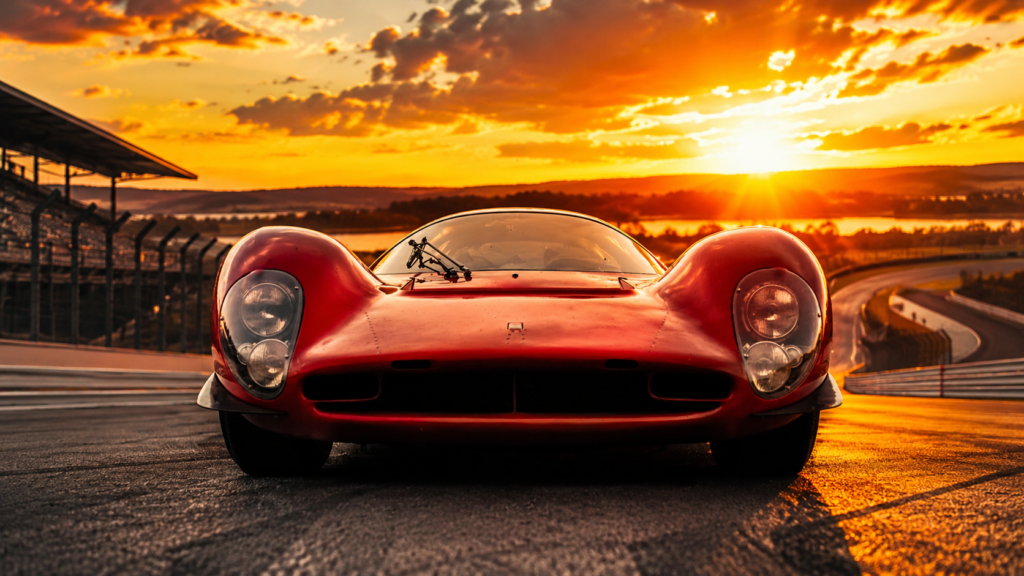
The 330 P4 was beautiful. The bodywork, designed by Piero Drogo and built by Fantuzzi, was low, sleek, and purposeful. The shape was similar to the P3, with subtle refinements to improve aerodynamics.
The front end featured a low nose with a prominent grille. The headlights were covered by clear lenses. The cockpit was a single bubble, with a curved windshield. The rear end was truncated, with a small spoiler.
Every curve and crease served a function. The bodywork channeled air to the radiators, cooled the brakes, and reduced drag.
The Sound: A V12 Symphony
The 330 P4’s V12 produced a sound that is the stuff of legend. At idle, it burbled and rumbled. At full throttle, it screamed. The note was high pitched, sharp, and mechanical. It was not the deep roar of a V8. It was the wail of a racing engine.
The sound is seared into the memory of anyone who has heard it. It is the sound of victory, of passion, of a golden era.
The Legacy: Beyond Daytona
The 330 P4 did not win Le Mans in 1967. That victory went to the Ford GT40. But the car’s legacy extends beyond its win-loss record.
The P4 is remembered as one of the most beautiful and successful race cars of its era. It represents the peak of Ferrari’s sports car program before the company shifted its focus to Formula 1.
The surviving P4s are among the most valuable cars in the world. When one changes hands, the price is measured in tens of millions of dollars. They are not just cars. They are works of art.
The Watkins Glen Evening
The sun has set over the Glen. The track is dark. The ghost of the 330 P4 has vanished.
But the legacy remains. In the museum, in the history books, in the hearts of enthusiasts, the P4 lives on.
The car that won Daytona. The car that beat Ford. The car that sang a V12 symphony. The Ferrari 330 P4.
Key Specifications
| Specification | Value |
|---|---|
| Engine | V12 |
| Displacement | 3,967.44 cc |
| Power | 331 kW (450 hp) at 8,000 rpm |
| Top Speed | 320 km/h (199 mph) |
| Cylinder Head | 3 valves per cylinder (2 intake, 1 exhaust) |
| Fuel System | Lucas fuel injection |
| Chassis | Modified from 330 P3, shorter wheelbase |
| Major Win | 1967 Daytona 24 Hours (1-2-3 finish) |
Conclusion
The Ferrari 330 P4 is more than a race car. It is a masterpiece of engineering and design. Franco Rocchi’s three valve V12, the beautiful Drogo bodywork, the historic 1-2-3 victory at Daytona these are the elements of a legend.
The car did not win Le Mans. But it won something more enduring. It won the hearts of enthusiasts.
The Watkins Glen track is quiet now. The red shape is gone. But the memory of the 330 P4, the sound of its V12, the sight of three red Ferraris crossing the finish line at Daytona these things will never fade.
They are the stuff of automotive history. They are the reason we love cars. They are the Ferrari 330 P4.

