
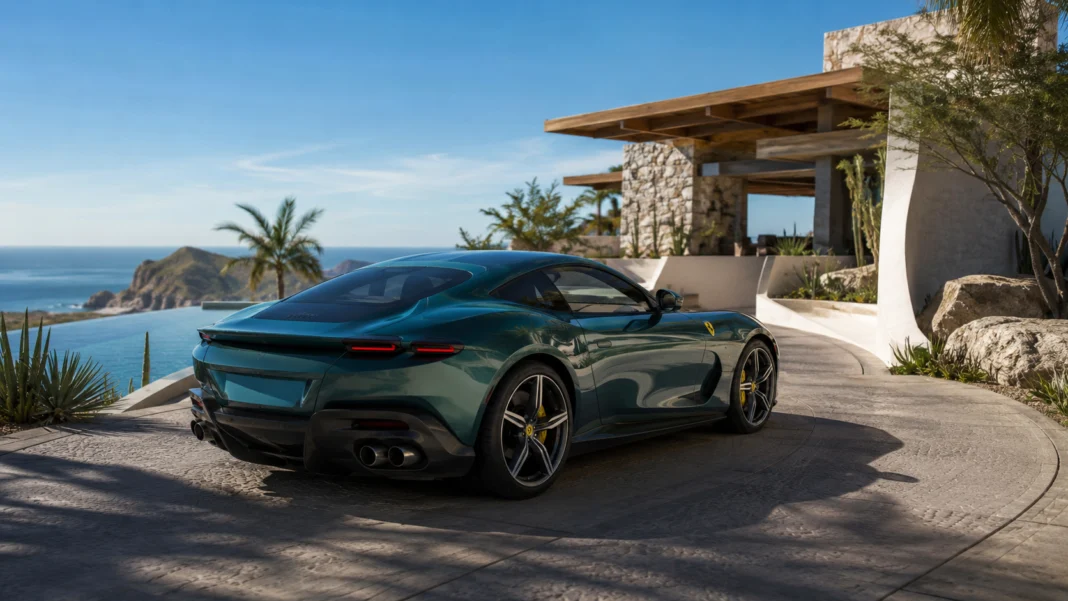
Imagine the lights of a villa glowing across an infinity pool as a low, sculpted silhouette glides up the drive, the sound of a V8 engine echoing off the stone walls and blending with the distant crash of waves against the cliffs of Los Cabos. That is the kind of evening the Ferrari Amalfi was made for, the car that replaces the Roma and brings back the physical buttons Ferrari drivers have been asking for.
The Amalfi is a front-mid-engine V8 2+2 coupe that Ferrari unveiled in July 2025. Named after the Italian coastal town, it represents a refinement of the Roma formula with more power, sharper design, and a cabin designed around tactile controls. It is the car that Ferrari hopes will attract new customers while satisfying existing ones.
The Name: A New Chapter
The Ferrari Amalfi is the successor to the Roma, which had been in production since 2019. The name change reflects a new direction for Ferrari’s entry-level GT. The car was unveiled in Amalfi, Italy, a UNESCO World Heritage site that embodies the elegance and beauty Ferrari aimed to capture.
The launch color, Verde Costiera, is a teal green inspired by the reflections of the sea along the Amalfi coast. It is a fresh, vibrant color that sets the tone for the car’s personality.
The Powertrain: A V8 Pushed Further
The heart of the Amalfi is a 3.9-liter twin-turbo V8 from Ferrari’s award-winning F154 family. The engine produces 640 cv (631 horsepower) at 7,500 rpm, a 20-horsepower increase over the Roma. The redline has been raised to 7,600 rpm.

The performance increase was achieved through a new Bosch ECU, advanced turbocharging management, and new pressure sensors. The turbochargers now spin up to 171,000 rpm, and the engine features a new control unit also used in the 296 GTB, Purosangue, and 12Cilindri.
The engine has also been lightened. New camshafts save 1.3 kg, and a redesigned engine block saves another 1 kg. A new low-viscosity oil has been introduced, reducing cold resistance by 30%.
The performance figures are impressive. The Amalfi accelerates from 0 to 100 km/h in 3.3 seconds and reaches a top speed of 320 km/h (199 mph). Power is sent to the rear wheels through an eight-speed dual-clutch F1 transmission.
The Chassis: Refined for Precision
The Amalfi’s chassis has been refined for a more engaging driving experience. The car features a 50:50 weight distribution, with the front-mid-engine layout contributing to excellent balance.
The suspension uses double wishbones at the front and a multi-link setup at the rear. The car rides on 20-inch wheels wrapped in high-performance tires. The brake-by-wire system includes ABS Evo, which improves braking precision on all surfaces. The Side Slip Control system integrates all dynamic controls, including steering, traction, and vertical suspension.
The steering has been recalibrated for improved precision and linearity. A new Electric Power Steering system includes a grip estimation function that is faster than the system in the 296.
The Design: Elegant and Aerodynamic
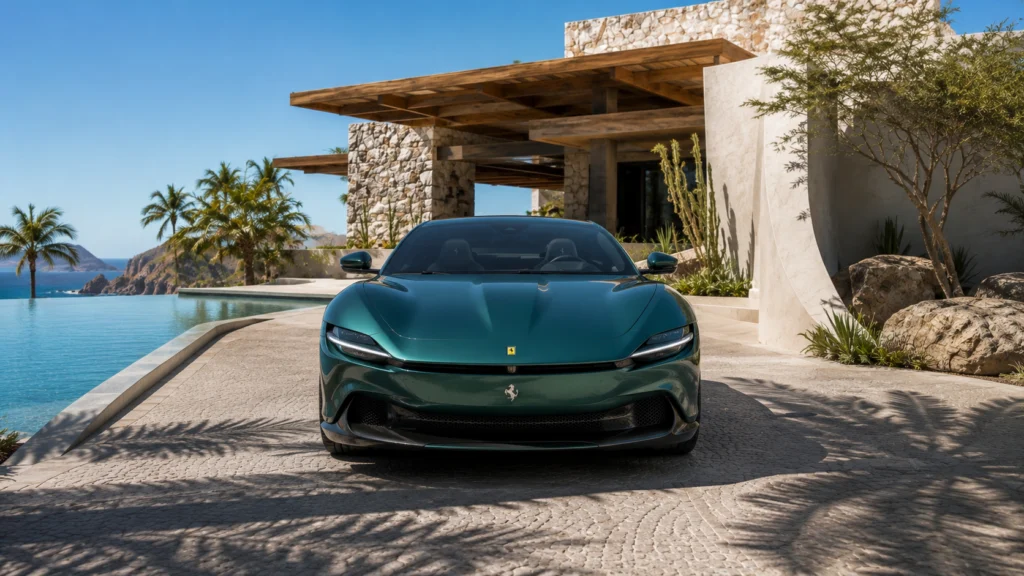
The Amalfi’s design is an evolution of the Roma’s elegant proportions. The exterior features a minimalist approach, with sharp lines and geometric volumes defining a sculpted, modern body. The front end abandons the traditional grille in favor of a body-colored spoiler above a dark recessed band that integrates the sensors and headlights.
The rear is defined by a strong character line and a compact tail. The taillights are hidden within graphic cuts, evoking classic Ferraris. The active rear spoiler can assume three configurations: Low Drag, Medium Downforce, and High Downforce. In the High Downforce position, it generates significant downforce at high speed.
The design is functional as well as beautiful. A bypass duct between the headlights channels air to cool the engine bay. The flat underbody and diffuser optimize airflow and improve aerodynamic efficiency.
The Interior: Buttons Are Back
The Amalfi’s interior is where the most significant change has occurred. The cabin features a dual-cockpit layout that envelops both driver and passenger. The dashboard has been simplified, with a clean, contemporary design.
The most notable change is the steering wheel. Ferrari has returned to physical buttons, replacing the touch-sensitive controls that frustrated many owners. The iconic red anodized start button is back on the left spoke. The controls are functionally distributed, with ADAS, phone, and voice controls on the left and display, wipers, and indicators on the right.

The HMI system includes three displays: a digital instrument cluster, a central touchscreen, and a passenger display. The system supports Apple CarPlay, Android Auto, and wireless charging. An optional premium audio system delivers high-quality sound through multiple speakers.
The seats are available with a massage function featuring multiple air chambers, programmes, and intensity levels. Ventilation is also available for both the seat and backrest.
The Los Cabos Evening
The Amalfi has completed its drive along the coast. Its V8 has delivered the 640 horsepower that makes it a worthy successor to the Roma. The active rear wing and chassis systems have kept it planted through the curves. The driver, cocooned in the dual-cockpit cabin, has experienced a level of performance that is both thrilling and accessible.
The Amalfi is not a car for everyone. It is a grand tourer for those who want a Ferrari that can be used every day, for those who appreciate the return of physical controls, and for those who value elegance as much as performance. But it represents a significant moment in Ferrari’s history. It is the car that acknowledges the importance of tactile feedback and the joy of driving.
The Amalfi is not just a car. It is a statement. It is a reminder that even in an era of screens and touch controls, Ferrari remains committed to the pure, unfiltered joy of driving. The buttons are back. And it has never been better.
Gear Picks for This Story
 EV LifeChargePoint Home Flex EV ChargerCheck Compatibility →
 Garage EssentialLiqui Moly 2041 Premium 5W-40 Motor Oil 5LExplore the Specs →
 Paddock StyleScuderia Ferrari Puma Polo ShirtSee the Design →
 Stay SafeRexing V1 Basic Dash CamSee How It Helps →
As an Amazon Associate, VeloxTrend earns from qualifying purchases.

