
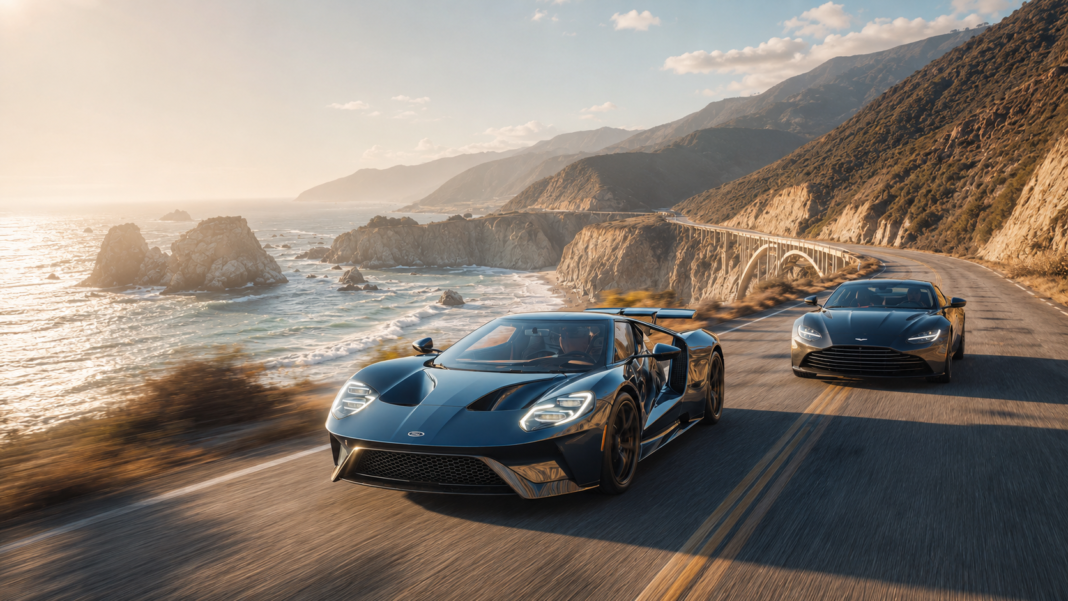
The Pacific Coast Highway stretches along the California coastline, a ribbon of asphalt that clings to cliffs overlooking the Pacific Ocean. The sun is setting over Big Sur, casting long shadows across the road. The air smells of salt and sagebrush. This is a road built for grand touring, for covering vast distances in comfort without sacrificing the thrill of driving.
Two cars have come to play on this legendary highway. The Ford GT, a mid-engine American supercar born from Le Mans winning DNA. The Aston Martin Vantage, a front-engine British grand tourer with a twin turbo V8 and a reputation for elegance. They are different in layout, philosophy, and price. Yet both are track bred. Both are grand tourers. Both are here to answer the same question: which one speaks to your soul?
The Contenders: Two Different Philosophies
Ford GT
The Ford GT is a mid-engine supercar. It is powered by a 3.5 liter twin turbo V6 producing 647 horsepower. The engine is based on the unit that powered Ford’s Le Mans winning GT race car. The car features a carbon fiber monocoque, active aerodynamics, and a seven speed dual-clutch transmission. The GT is designed to be a track weapon that can also be driven on the street.
Aston Martin Vantage
The Aston Martin Vantage is a front-engine grand tourer. It is powered by a 4.0 liter twin turbo V8 sourced from Mercedes AMG, producing 503 horsepower. The car features an aluminum chassis, a rear mounted eight speed automatic transmission, and a limited slip differential. The Vantage is designed to be a stylish, comfortable grand tourer with genuine sporting credentials.
Big Sur: A Road Built for Grand Touring
The Pacific Coast Highway between Carmel and San Simeon is one of the most beautiful driving roads in the world. The road twists and turns along the coastline, with elevation changes and off-camber corners that demand attention. This is not a racetrack. It is a public highway, and driving at the limit is not advisable. But it is a place where a car’s character becomes clear.
The Ford GT attacks the road with aggression. The mid-engine layout provides exceptional turn in, and the active aerodynamics keep the car planted. The driver feels every input, and the car responds instantly.
The Aston Martin Vantage is more relaxed. The front-engine layout gives it a different rhythm. The car flows through corners, the chassis communicating clearly but not urgently. The driver can cover ground quickly without feeling rushed.
Performance: Numbers for the Track and the Road
Ford GT
- Engine: 3.5L twin turbo V6
- Horsepower: 647 hp at 6,250 rpm
- Torque: 550 lb-ft
- Transmission: 7 speed dual-clutch
- Drive: Rear wheel drive
- 0 to 60 mph: 3.0 seconds
- Top Speed: 216 mph
- Weight: 3,354 lb
Aston Martin Vantage
- Engine: 4.0L twin turbo V8
- Horsepower: 503 hp at 6,000 rpm
- Torque: 505 lb-ft
- Transmission: 8 speed automatic
- Drive: Rear wheel drive
- 0 to 60 mph: 3.5 seconds
- Top Speed: 195 mph
- Weight: 3,373 lb
Performance Verdict
The Ford GT is significantly more powerful and quicker. Its 647 horsepower is 144 more than the Vantage’s 503. The GT’s 0 to 60 time of 3.0 seconds is half a second quicker than the Vantage’s 3.5 seconds. The GT also has a higher top speed.
The Vantage is not a slow car, but it is not in the same performance league as the GT.
Chassis and Handling: Two Paths to Grip
Ford GT
The Ford GT’s carbon fiber monocoque is rigid and light. The suspension uses double wishbones at all four corners, with pushrod actuated dampers. The active aerodynamics, including a deployable rear wing and front splitter, adjust to balance downforce and drag.
The GT is a precise instrument. The steering is direct and communicative, providing excellent feedback. The car changes direction eagerly, and the rear wheel drive layout requires careful throttle management. On a track, the GT is exceptionally fast.
Aston Martin Vantage
The Vantage’s aluminum chassis is also rigid. The suspension uses double wishbones at the front and a multi-link rear. The car features an electronic limited slip differential that manages torque distribution between the rear wheels.
The Vantage is more forgiving than the GT. The steering is precise but less urgent. The car is stable and predictable, and the rear wheel drive layout is more manageable. On a winding road, the Vantage is enjoyable and accessible.
Handling Verdict
The Ford GT is the more capable car on a track. Its mid-engine layout, active aerodynamics, and carbon fiber construction make it a weapon. The Aston Martin Vantage is the more accessible car on a winding road. It is easier to drive quickly without requiring the same level of skill.
Design: American Aggression vs British Elegance
Ford GT
The Ford GT’s design is dramatic and aggressive. The low nose, large air intakes, and flying buttresses give it a purposeful, race car appearance. The dihedral doors open upward, adding to the drama. The GT is available in a range of colors, including the iconic Gulf livery.
Aston Martin Vantage
The Vantage’s design is elegant and muscular. The front end features the signature Aston Martin grille and sharp LED headlights. The side profile shows a long hood and a fastback roofline. The rear end is clean and sculpted.
Design Verdict
The Ford GT is the more dramatic and eye catching car. It looks like a race car for the road. The Aston Martin Vantage is more elegant and understated. It appeals to drivers who prefer subtlety over aggression.
Interior: Function vs Luxury
Ford GT
The Ford GT’s interior is functional and driver focused. The seats are fixed, with adjustable pedals and steering column. The materials are high quality, with carbon fiber, Alcantara, and leather throughout. The infotainment system is basic but functional.
The interior is not luxurious, but it is not supposed to be. The GT is a car for driving, not for lounging.
Aston Martin Vantage
The Vantage’s interior is more luxurious. The seats are comfortable and supportive, with power adjustment and heating. The materials are exceptional, with fine leather, Alcantara, and metal trim. The infotainment system is more sophisticated than the Ford’s.
The Vantage is a car that can be used for long distance touring in comfort.
Interior Verdict
The Aston Martin Vantage has the more luxurious and comfortable interior. The Ford GT is more functional and driver focused.
The Pacific Coast Highway: A Moment in Time
As the sun dips below the horizon, the two cars pull into a vista point overlooking the ocean. The Ford GT’s dihedral doors are open, and the driver is reviewing telemetry data on the display. The Aston Martin Vantage’s engine ticks quietly as it cools.
They are different cars for different drivers. The Ford GT is for the enthusiast who wants to feel like a race car driver, who values lap times and track capability above all else. The Aston Martin Vantage is for the enthusiast who wants to cover ground in style, who values elegance and comfort as much as performance.
Value and Ownership
Pricing
The Ford GT has a base price of approximately $500,000. However, the application process and limited production mean that most buyers paid $650,000 or more. The Aston Martin Vantage has a base price of approximately $150,000. The Ford is significantly more expensive.
Exclusivity
The Ford GT was limited to 1,350 units over a five year production run. The Aston Martin Vantage is a volume model, with thousands of units produced. The Ford is rarer and more exclusive.
Ownership Costs
Both cars are expensive to maintain. The Ford GT’s specialized components and limited production make parts difficult to source. The Aston Martin’s Mercedes AMG engine is more common, but service costs are still high.

Which One Speaks to Your Soul?
Choose the Ford GT if:
- You want a car with racing heritage and track capability.
- You value exclusivity and rarity.
- You prefer an aggressive, dramatic design.
- You are willing to accept a less luxurious interior.
- You have the budget for a $500,000 plus car.
Choose the Aston Martin Vantage if:
- You want a car that is elegant and refined.
- You value comfort and luxury for long distance touring.
- You prefer a more understated design.
- You want a car that is easier to drive quickly on winding roads.
- You want better value. The Vantage is significantly less expensive.
Specifications Summary
| Specification | Ford GT | Aston Martin Vantage |
|---|---|---|
| Engine | 3.5L twin turbo V6 | 4.0L twin turbo V8 |
| Horsepower | 647 hp | 503 hp |
| Torque | 550 lb-ft | 505 lb-ft |
| Transmission | 7 speed dual-clutch | 8 speed automatic |
| Drive | Rear wheel drive | Rear wheel drive |
| 0 to 60 mph | 3.0 seconds | 3.5 seconds |
| Top Speed | 216 mph | 195 mph |
| Weight | 3,354 lb | 3,373 lb |
| Base Price | $500,000+ | $150,000 |
| Character | Aggressive, track focused, exclusive | Elegant, comfortable, accessible |
Conclusion
The Ford GT and the Aston Martin Vantage are two very different interpretations of the track bred grand tourer. The Ford GT is a race car for the road. It is expensive, exclusive, and demanding. It rewards skilled drivers with exceptional performance.
The Aston Martin Vantage is a grand tourer with a sporting edge. It is elegant, comfortable, and accessible. It rewards drivers who appreciate style and finesse.
Which one speaks to your soul? The Ford GT speaks to the driver who wants to conquer the track. The Aston Martin Vantage speaks to the driver who wants to enjoy the journey.
Both will put a smile on your face. Both are legends. As the stars appear over the Pacific, the two cars head their separate ways. The GT turns inland, toward the racetrack. The Vantage continues south, following the coast. Neither is wrong. Both are right. The choice is yours.

