
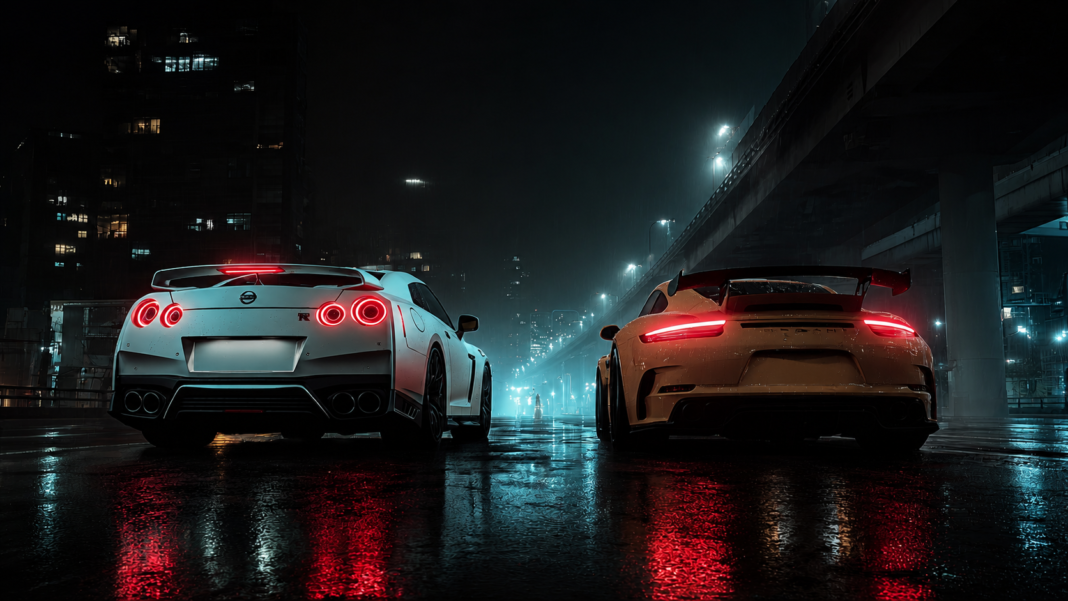
Tokyo at night is a different world. The neon glow of Shibuya reflects off the rain slicked asphalt of the Shuto Expressway. The city that never sleeps hums with energy, and at its heart, the elevated expressway becomes a proving ground for a specific breed of enthusiast. The Bayshore Route, with its long straights and sweeping curves, is a place where Japan’s finest performance machinery has been tested for decades.
It is here that the Nissan GT-R R35, known to fans around the world as Godzilla, feels most at home. Yet tonight, it shares the rain slicked pavement with a rival from across the sea. The Porsche 911 Turbo S, the benchmark of all weather, everyday supercar performance, has come to play.
Since 2007, the Nissan GT-R and the Porsche 911 Turbo have been locked in a debate. The R35 generation, now in its final years, redefined what was possible from a Japanese performance car. The 992 Turbo S represents the latest generation of Stuttgart’s finest, a car that seems to defy physics with its launch control and all wheel drive.
This is a comparison not just of numbers, but of philosophies. A quarter mile, track, and value analysis that has started arguments in parking lots and online forums for nearly two decades.
The Contenders: Two Titans of All Weather Performance
Nissan GT‑R R35
The Nissan GT‑R is a front-engine, all wheel drive coupe. It is powered by a hand built 3.8 liter twin turbo V6, the legendary VR38DETT. In its final Nismo form, it produces approximately 600 horsepower and 481 lb-ft of torque. The car is equipped with a six speed dual-clutch transmission and an advanced all wheel drive system that can vary torque distribution between the front and rear axles. The GT‑R is designed to be a supercar slayer, delivering exotic performance at a fraction of the price.
Porsche 911 Turbo S
The Porsche 911 Turbo S is a rear-engine, all wheel drive coupe. It is powered by a 3.7 liter twin turbo flat six engine producing 640 horsepower and 590 lb-ft of torque. The car uses an eight speed dual-clutch transmission and Porsche’s advanced traction management system. The Turbo S is designed to be the ultimate everyday supercar, combining comfort, all weather capability, and blistering speed.
Shuto Expressway: Where Legends Are Made
The Bayshore Route of the Shuto Expressway is not a racetrack. It is a public highway, and driving at the limit is illegal and dangerous. But in the quieter hours of the night, the long, lit tunnels and sweeping corners have become a place where car culture thrives. The GT‑R has long been the king of this domain. Its launch control and all wheel drive make it brutally effective from a stoplight, and its stability at high speed is legendary.
The Porsche 911 Turbo S, with its rear engine layout and higher power output, is a different beast. It demands a lighter touch, a more delicate application of power. But when driven correctly, it is unstoppable.
Quarter Mile: The Drag Strip in the City
The Shuto Expressway does not have a drag strip, but the long straights between the tunnels serve the same purpose. From a standing start, the GT‑R is a missile. Its launch control system, perfected over years of development, delivers consistent, brutal acceleration.
- Nissan GT‑R R35 Nismo: 0 to 60 mph in 2.5 seconds. Quarter mile in 10.8 seconds at 130 mph.
- Porsche 911 Turbo S: 0 to 60 mph in 2.6 seconds. Quarter mile in 10.5 seconds at 135 mph.
The numbers are close, nearly identical. The GT‑R has the edge to 60 mph, but the Turbo S has more power and a higher trap speed. On the street, from a stoplight, the result is a driver’s race.
The Tunnels: Track Performance on Public Roads
The tunnels of the Shuto Expressway are where the handling differences become apparent. The concrete walls amplify the sound of the engines, and the lack of runoff means the driver must be precise.
The Nissan GT‑R feels planted and secure. The all wheel drive system provides immense grip, and the car rotates predictably. The steering is heavy and communicative. The GT‑R is a car that flatters the driver, allowing them to push hard without fear.
The Porsche 911 Turbo S is more demanding. The rear engine layout requires the driver to manage weight transfer carefully. But the rewards are significant. The Turbo S rotates on corner entry and puts power down exiting corners with authority.
Value: The Godzilla Advantage
The Nissan GT‑R has always been about value. When it debuted in 2008, it delivered supercar performance for less than $70,000. Today, the GT‑R Nismo starts at approximately $220,000. The Porsche 911 Turbo S starts at approximately $200,000.
The price gap has narrowed significantly. The GT‑R is no longer the bargain it once was. However, the GT‑R offers exclusivity. Production numbers are low, and the car has a cult following that the Porsche cannot match.
The Porsche offers a more luxurious interior, a more refined ride, and the prestige of the Porsche badge. For many buyers, the extra cost is justified.
Daily Driving: Comfort vs Capability
The Porsche 911 Turbo S is the better daily driver. The interior is quiet and comfortable. The suspension absorbs road imperfections. The car is easy to drive in traffic, with a smooth dual-clutch transmission.
The Nissan GT‑R is more raw. The ride is firm, the cabin is loud, and the dual-clutch transmission can be jerky at low speeds. The GT‑R is a car that always feels alive, even when driving slowly. Some owners prefer that. Others find it tiring.
The Tokyo Night: A Moment in Time
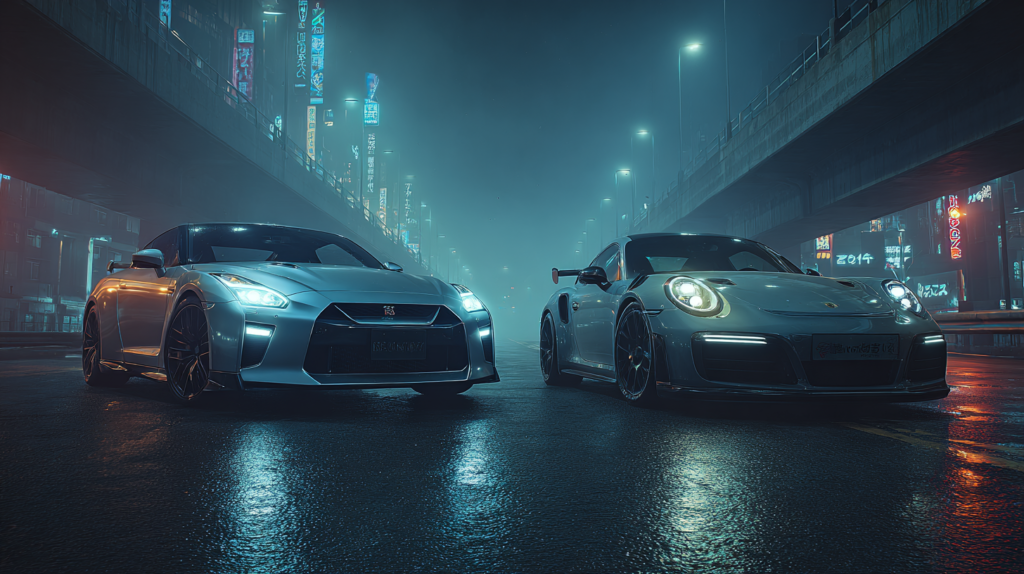
As the rain begins to fall harder on the Shuto Expressway, the two cars slow to a crawl. The GT‑R’s wipers clear the windshield. The Turbo S’s headlights cut through the spray. Side by side, they are a study in contrasts.
The GT‑R is a aggressive, sharp edged machine. It looks like it was carved from a single block of carbon fiber. The Turbo S is smoother, more elegant, its curves refined over generations.
They are both extraordinary. They are both legends. And they are both fading. The R35 GT‑R is nearing the end of its long production life. The 992 Turbo S will eventually be replaced by a hybrid.
But tonight, on the Shuto Expressway, they are timeless.
Which One Wins the Argument?
The debate has continued for years. There is no clear winner.
Choose the Nissan GT‑R R35 if:
- You want a car with a cult following and a raw, unpolished character.
- You value exclusive, low production numbers.
- You prefer a car that feels aggressive and demanding.
- You are willing to accept a firmer ride and a louder cabin.
Choose the Porsche 911 Turbo S if:
- You want a car that is refined, luxurious, and comfortable.
- You value the prestige of the Porsche badge.
- You want a car that is easy to drive every day.
- You prefer a smoother, more elegant design.
The Verdict from the Shuto Expressway
The Nissan GT‑R and the Porsche 911 Turbo S are two of the greatest performance cars of their generation. The GT‑R is an icon, a car that changed the rules. The Turbo S is a benchmark, a car that has been refined to near perfection.
The GT‑R is the better value. It offers performance that rivals cars costing twice as much. The Turbo S is the better luxury car. It offers a level of refinement and comfort that the GT‑R cannot match.
On the Shuto Expressway, both are capable of breathtaking speed. Both will put a smile on your face. Both are legends.
Specifications Summary
| Specification | Nissan GT‑R R35 Nismo | Porsche 911 Turbo S |
|---|---|---|
| Engine | 3.8L twin turbo V6 | 3.7L twin turbo flat six |
| Horsepower | 600 hp | 640 hp |
| Torque | 481 lb-ft | 590 lb-ft |
| Transmission | 6 speed dual-clutch | 8 speed dual-clutch |
| Drive | All wheel drive | All wheel drive |
| 0 to 60 mph | 2.5 seconds | 2.6 seconds |
| Quarter mile | 10.8 seconds at 130 mph | 10.5 seconds at 135 mph |
| Top Speed | 196 mph | 205 mph |
| Base Price | $220,000 | $200,000 |
| Character | Raw, aggressive, demanding | Refined, comfortable, easy |
Conclusion
The Nissan GT‑R R35 and the Porsche 911 Turbo S are two of the most significant performance cars of the 21st century. They represent different approaches to speed. The GT‑R is a street fighter. The Turbo S is a precision instrument.
The GT‑R wins the quarter mile. The Turbo S wins on the track. The GT‑R wins on emotion. The Turbo S wins on refinement.
The argument will continue as long as there are car enthusiasts. And that is the beauty of it. There is no right answer. There is only the drive.
As the rain clears over Tokyo, the two cars disappear into the night. The GT‑R’s exhaust echoes off the tunnel walls. The Turbo S’s flat six hums quietly. They are gone, but the debate lingers.

