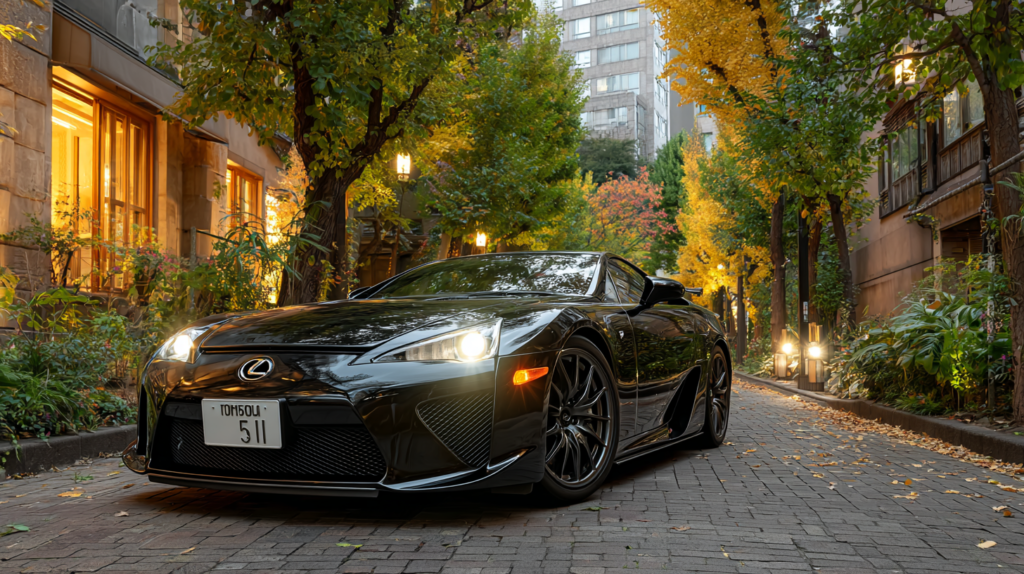

In the world of high performance automobiles, certain vehicles transcend their model designation to become cultural and engineering touchstones. The Lexus LFA is one such machine. Produced for a mere two years between 2010 and 2012, this front engine, rear drive coupe represented a departure from the traditional Lexus philosophy. Instead of focusing on quiet luxury and ride comfort, the brand’s parent company, Toyota, tasked its engineers with building a vehicle that could compete with the established European exotic car hierarchy.
More than a decade after production ceased, the LFA remains a subject of fascination. Its naturally aspirated V10 engine, developed in collaboration with Yamaha, produces a sound that is frequently described as one of the best in automotive history. Its construction utilized advanced carbon fiber reinforced polymer, a material not commonly used at scale by Japanese manufacturers at the time. This article provides a detailed look at the specifications, engineering philosophy, market position, and lasting legacy of the Lexus LFA.
The Genesis of an Icon
The story of the LFA begins not with a market demand analysis, but with an internal desire to prove capability. In the early 2000s, Toyota’s leadership recognized that the brand lacked a halo car—a vehicle that existed not for high sales volume, but to demonstrate the absolute peak of the company’s technological prowess.
The project, initially known as the P280, underwent a lengthy development cycle. Early prototypes featured an all aluminum body and a V8 engine. However, as development progressed and goals shifted, the engineering team decided to pivot toward a more ambitious concept. They abandoned aluminum in favor of carbon fiber composites and replaced the planned V8 with a purpose built V10. This decision delayed the launch but ultimately defined the vehicle’s character.
When the production version was finally unveiled in 2009, it was clear that the development team had created something unique. It was not the fastest car in a straight line compared to its contemporaries from Italy or Germany. It was not the most luxurious grand tourer. Instead, it was a machine built around the driver, prioritizing response, feedback, and emotional engagement.
Engineering Analysis: The 4.8 Liter V10
At the heart of the LFA is its engine. The 4.8 liter V10, codenamed 1LR GUE, was developed in partnership with Yamaha, a company with extensive experience in both musical instruments and engine development for other manufacturers. This partnership influenced two key aspects of the engine: its internal balance and its acoustic properties.
The engine produces 552 horsepower at 8,700 rpm and 354 lb ft of torque at 6,800 rpm. These figures, while impressive, do not tell the full story. The critical element is the engine’s willingness to rev. It can accelerate from idle to its 9,000 rpm redline faster than the engine in many contemporary sports cars. Yamaha’s engineers focused on reducing the rotating mass of the internal components. Titanium connecting rods, forged pistons, and a lightweight crankshaft allow the engine to change speed with minimal inertia.
The lubrication system uses a dry sump design. This allows the engine to be mounted lower in the chassis for a reduced center of gravity and ensures consistent oil pressure during high g cornering. The intake system features individual throttle bodies for each cylinder, contributing to the immediate throttle response.
The Acoustic Signature
The sound produced by the LFA’s exhaust is a primary reason for its continued fame. Unlike forced induction engines that produce a compressed rush of air, or traditional V8s with their burble, the LFA’s V10 creates a high frequency wail.
This was not an accidental byproduct. Yamaha’s acoustic engineers designed the intake and exhaust systems to produce specific harmonic frequencies. The intake snorkel, which draws air from behind the rear wheel, and the titanium exhaust manifold and muffler were tuned to create a clean, musical tone as the engine climbs toward its 9,000 rpm limit.
The result is a sound that climbs in pitch linearly with engine speed, often compared to the sound of a Formula One car from the early 2000s, when the sport also utilized high revving V10 engines. This auditory feedback provides the driver with a constant stream of information about the engine’s state without needing to look at the tachometer.
Carbon Fiber Construction and Chassis Dynamics
When the development team decided to pursue a carbon fiber monocoque, they faced a significant challenge. At the time, producing carbon fiber components in the volumes required for a production vehicle (even a low volume one) was not a core competency for Toyota. To solve this, the company established a new production facility and developed a specific manufacturing process.
The chassis is constructed from carbon fiber reinforced polymer, with aluminum subframes attached at the front and rear to carry the suspension and engine components. The use of carbon fiber allowed the engineers to achieve a high level of structural rigidity while keeping the curb weight to approximately 3,263 pounds. This is notably light for a car with a large engine, rear wheel drive layout, and the safety equipment required for modern road use.
The weight distribution is 48 percent front and 52 percent rear. The suspension consists of double wishbones at all four corners, fabricated from aluminum for low unsprung mass. The brakes, developed in partnership with Brembo, use carbon ceramic rotors to resist fade during repeated hard use.
Transmission and Performance Metrics
The LFA was offered with a single transmission option: a six speed automated sequential gearbox. Unlike modern dual clutch units, this transmission is a single clutch design. It was mounted at the rear axle to improve weight distribution, creating a transaxle layout.
This choice is one of the more frequently discussed aspects of the car. A single clutch transmission cannot shift as quickly as a modern dual clutch unit. However, the engineers prioritized the feel of the shift mechanism. They worked with a supplier to develop a system that would deliver a more positive, mechanical engagement. The shift times can be adjusted by the driver, with settings that quicken the gear changes for track use.
In terms of performance, the LFA records a 0 to 60 miles per time of approximately 3.6 seconds. Its top speed is rated at 202 miles per hour. While these numbers have since been surpassed by less exotic machinery, the manner in which the LFA achieves them is what sets it apart. It does not rely on all wheel drive traction or launch control systems to mask driver error. It requires skill to extract its full potential.
Production Numbers and Rarity
Lexus planned a limited production run for the LFA from the outset. Originally, the company intended to build 500 units. This number was chosen to ensure exclusivity while allowing the specialized production facility to operate efficiently.
The allocation process was unusual. Lexus did not simply take orders from the public. Instead, they invited current customers and collectors to apply for the opportunity to purchase one. This created a gatekept market from the beginning. All 500 units were spoken for before production ended in December 2012.
Of these 500 cars, a small number were designated as Nurburgring Package editions. These featured additional aerodynamic components, a slightly lowered suspension, revised tuning, and a small power increase to 562 horsepower. These models are particularly sought after by collectors.
Market Positioning and Original Pricing
When new, the Lexus LFA carried a base price of approximately $375,000. This placed it in direct competition with established exotic cars from Ferrari, Lamborghini, and Porsche. At that price point, it was the most expensive Japanese production car ever sold.
This pricing strategy was met with some skepticism at launch. Critics questioned whether buyers accustomed to the heritage of Maranello or Stuttgart would embrace a new entrant from a brand known for sedans and SUVs. The LFA did not need to win a sales war, however. Its purpose was to exist, to demonstrate capability, and to change perceptions of the brand.
The business case for the LFA was not built on profitability. Industry analysts have estimated that the development and production costs far exceeded the revenue generated by the 500 units. It was an exercise in brand building and engineering ambition.
The LFA in the Context of Japanese Engineering
To understand the LFA’s significance, it is helpful to consider the history of Japanese performance cars. In the late 1980s and early 1990s, Japanese manufacturers produced a wave of sports cars like the Nissan Skyline GT R, Mazda RX 7, and Toyota Supra. These cars were celebrated for their performance relative to their price.
The LFA took a different approach. It ignored the value proposition entirely. It was engineered without a strict cost ceiling. This allowed the team to use exotic materials and develop a unique engine without the constraints that apply to mass production vehicles. In this sense, it is more closely related to homologation specials like the Toyota GT One than to the Supra.
It demonstrated that a Japanese manufacturer could operate at the highest level of the automotive food chain, not by offering more for less, but by matching or exceeding the engineering rigor of the European establishment.
The Collector Market and Current Valuation
In the years following the end of production, the LFA has experienced a significant appreciation in value. This is common for limited production halo cars, but the trajectory of the LFA has been particularly steep. Well maintained examples with low mileage now trade for prices well above their original window stickers, often exceeding $700,000 or $800,000 at private sales and auctions.
Several factors drive this demand. The limited production run of 500 units ensures scarcity. The car’s unique engine and sound give it a character that cannot be replicated by modern turbocharged hybrids. It also represents a moment in time—the peak of naturally aspirated internal combustion development before the industry shifted toward electrification and forced induction.
The Nurburgring Package editions command the highest premiums. Their rarity, combined with the visual differentiation provided by the fixed rear wing and carbon fiber components, makes them the most desirable variant for serious collectors.
Living with the LFA
For the few owners who choose to drive their LFA rather than store it, the ownership experience is distinct from that of a modern supercar. The interior is functional but not opulent. The materials are high quality, with extensive use of Alcantara and carbon fiber, but the design is focused on the driver rather than on luxury.
The digital instrument cluster moves physically as the revs increase, a mechanical touch that reinforces the car’s focus on the driving experience. Visibility is adequate, and the car is manageable in traffic, though the single clutch transmission is less convenient in stop and go driving than modern torque converter automatics or dual clutch units.
Servicing a carbon fiber vehicle requires specialized knowledge. Body repairs cannot be performed by a standard body shop. The engine, while robust, requires care to reach operating temperature before being pushed to its 9,000 rpm redline. These considerations are part of the ownership commitment for any exotic vehicle.
The LFA and Motorsport Pedigree
To validate the engineering of the LFA and to connect it with Toyota’s racing history, the company developed a track only version known as the LFA Code X. This car was not intended for road use. It featured a stripped interior, a roll cage, and significant aerodynamic modifications. It was used as a test bed for future technologies and as a pace car for various events.
More significantly, the LFA shared engineering DNA with Toyota’s endurance racing efforts. The emphasis on aerodynamic efficiency, weight reduction, and engine response are all traits valued in motorsport. While the LFA itself did not compete in a major racing series, it served as a technological bridge between Toyota’s road car division and its Gazoo Racing motorsport arm, which would later achieve success with cars like the TS050 Hybrid and the GR010.
Why the LFA Matters Today
In the current automotive landscape, where performance is often measured by acceleration times and digital features, the LFA serves as a reminder of a different set of priorities. It was not designed to win spec sheet comparisons. It was designed to provide a sensory experience.
The sound of the V10, the response of the throttle, the feedback through the chassis, and the knowledge that every component was chosen for its contribution to the driving experience make it significant. It represents a point where a major corporation gave its engineers the resources and freedom to build something without compromise.
For those interested in automotive history, the LFA is a case study in ambition. It shows how a brand can redefine itself not through marketing, but through the creation of a physical object that challenges preconceptions. It remains, by any objective measure, one of the most accomplished vehicles to emerge from Japan.
Frequently Asked Questions
What is the redline of the Lexus LFA engine?
The engine is designed to rev safely to 9,000 rpm, providing a broad power band and a distinctive climbing exhaust note.
How many Lexus LFA units were produced?
Lexus built 500 cars for global distribution, with each unit assigned to a specific customer through an application process.
What is the Nurburgring Package?
It is an optional performance package available on approximately 50 of the 500 cars. It adds a fixed rear wing, front canards, forged wheels, retuned suspension, and a slight increase in horsepower.
Is the LFA expensive to maintain?
As a low production exotic vehicle, maintenance costs are higher than for standard vehicles. Parts availability is managed by Lexus, but specialized service is required for the carbon fiber structure and the high performance engine.
Does the LFA hold its value?
Yes. Due to its limited production, unique engineering, and status as a modern collectible, the LFA has appreciated significantly in the secondary market. Values continue to rise as demand from collectors remains strong.