

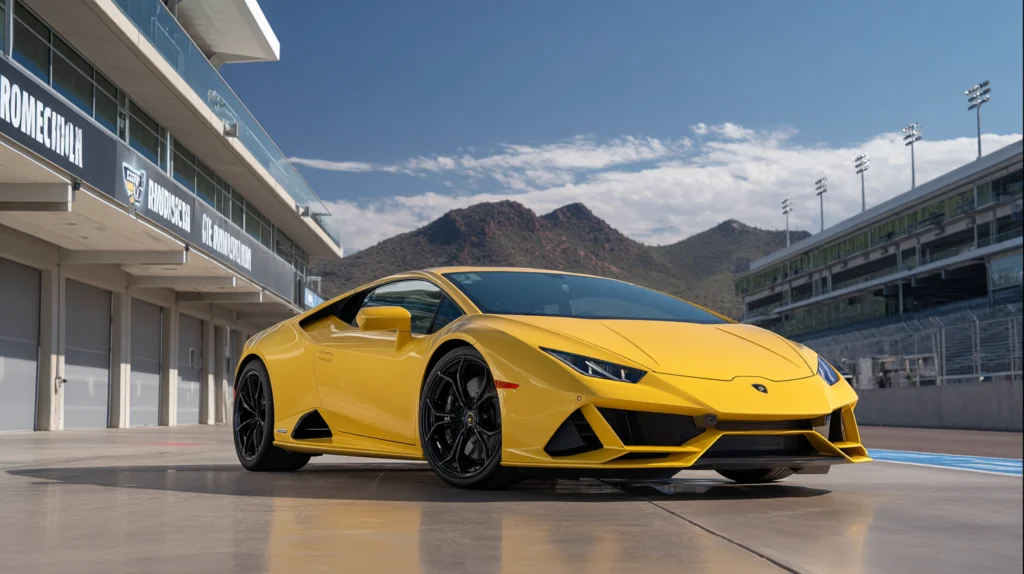
The Lamborghini Huracán makes the most sense on a racetrack, where its 5.2 liter V10 and mid-engine balance come alive. On a private circuit like the Podium Club southeast of Phoenix, Arizona, with an instructor guiding a driver through a series of corners, it is easy to see why so many buyers fall for it.
The Lamborghini Huracán is the most accessible entry into the world of the Raging Bull. It replaced the Gallardo and has become Lamborghini’s best-selling model of all time. But buying a used Huracán is not like buying a used Honda Civic. There are specific things every buyer needs to know about the different generations, common issues, maintenance costs, and the driving experience before signing.
This guide covers everything you need to know before buying a used Lamborghini Huracán.
The Location: Podium Club, Casa Grande, Arizona
The Podium Club is a motorsports country club with a 2.4 mile circuit. It is the perfect place to understand the Huracán. On public roads, the car is stiff, loud, and occasionally frustrating. On a track, it transforms into a precise, responsive, and thrilling machine. The instructors here have logged thousands of miles in Huracáns. They know the car’s strengths, weaknesses, and what to look for in a used example.
The Generations: LP 610-4, LP 580-2, Performante, EVO, and STO
The Huracán was produced from 2014 to 2024. The lineup is confusing, with multiple variants and updates. Understanding the differences is the first step to buying the right car.
LP 610-4 (2014 to 2019)
The original Huracán. The LP stands for Longitudinale Posteriore, referring to the longitudinal mid-engine layout. The 610 refers to the metric horsepower. The 4 refers to all-wheel drive. The 610-4 has a 5.2 liter V10 producing 602 horsepower. It is the most common and affordable Huracán.
LP 580-2 (2016 to 2019)
The rear-wheel drive version of the original Huracán. It has 572 horsepower. The 580-2 is lighter, more playful, and less expensive than the 610-4. It is the choice for drivers who prefer oversteer to understeer.
Performante (2017 to 2019)
The Performante was the first high-performance variant. It has 631 horsepower. The active aerodynamics, lightweight materials, and Nürburgring lap record made it a legend. The Performante is more expensive and more focused than the standard car.
EVO (2020 to 2023)
The EVO was a significant update. The styling was revised. The rear-wheel steering was added. The infotainment system was improved. The EVO has 631 horsepower (640 in the RWD version). The EVO is more refined and more capable than the original car.

STO (2021 to 2024)
The STO is the most extreme Huracán. It stands for Super Trofeo Omologata. It is a road-legal version of the Huracán Super Trofeo race car. The STO has 631 horsepower, rear-wheel drive, and massive aerodynamics. It is the closest thing to a race car you can drive on the street.
What to Look For: Common Issues and Red Flags
The Huracán is generally reliable for a supercar. The V10 is robust. The dual-clutch transmission is durable. But there are some common issues that buyers should be aware of.
The Brakes
The carbon ceramic brakes are expensive to replace. A full set of pads and rotors costs approximately $10,000 to $15,000. Check the brake pad wear during an inspection. If the pads are near the end of their life, factor the replacement cost into your offer.
The Tires
The Huracán wears staggered tires. The rear tires are significantly wider than the front tires. A set of performance tires costs $2,000 to $3,000 and typically lasts 6,000 to 10,000 miles. Check the tread depth. Look for uneven wear, which can indicate alignment issues.
The Lifting System
The front axle lifting system is a common failure point. The system raises the front of the car to clear speed bumps and driveways. Over time, the hydraulic lines can leak, and the pumps can fail. Test the lifting system during the test drive.
The Air Conditioning
The air conditioning system on early Huracáns can be weak. Check the A/C performance during the test drive. If the system is not blowing cold air, the repair may be expensive.
The Infotainment System
The infotainment system on pre-EVO cars is dated. The graphics are low resolution. The system can be slow. This is not a mechanical issue, but it may affect your enjoyment of the car.
The Service History
A complete service history is critical. The Huracán requires annual service or service every 10,000 miles. A major service, which includes the spark plugs and various filters, is required every 30,000 miles. Missing service records are a red flag.
The Instructors’ Advice: What They Look For
The instructors at the Podium Club have driven dozens of Huracáns. They know which cars are well-maintained and which cars have been abused.
“The biggest red flag is a car that has been tracked without proper maintenance,” one instructor says. “Track driving is hard on brakes, tires, and fluids. If the owner did not upgrade the brake fluid or replace the pads before track days, the car may have underlying issues.”
Another instructor looks for tire wear. “If the rear tires are bald and the front tires have plenty of tread, the owner was driving the car hard. That is not necessarily a problem, but it means the car will need new tires soon.”
They also recommend an independent pre-purchase inspection. “A mechanic who specializes in exotics can spot problems that the untrained eye will miss.”
The Cost of Ownership: Beyond the Purchase Price
The purchase price is only the beginning. The true cost of owning a Huracán includes maintenance, tires, insurance, and storage.
Maintenance
Annual service costs approximately $1,500 to $3,000. The 30,000 mile major service costs approximately $5,000 to $8,000.
Tires
A set of tires costs $2,000 to $3,000 and lasts 6,000 to 10,000 miles.
Insurance
Insurance costs vary. Expect to pay $3,000 to $10,000 per year, depending on your driving record, location, and coverage.
Storage
If you do not have a secure garage, you will need to rent storage. Expect to pay $300 to $1,000 per month.
Depreciation
The Huracán has held its value better than many supercars. The LP 610-4 has stabilized in the $140,000 to $180,000 range. The Performante and STO have held their value even better.
The Driving Experience: What to Expect
The Huracán is not a subtle car. The V10 is loud, even at idle. The ride is firm, and the interior is not particularly luxurious. On a smooth road, the car is exhilarating. On a rough road, it is punishing.
The steering is quick and responsive. The all-wheel drive system provides exceptional traction. The car feels planted and secure, even at high speeds.
The rear-wheel drive versions (LP 580-2 and STO) are more playful. They rotate on corner entry and allow the driver to adjust the cornering attitude with the throttle.
The EVO added rear-wheel steering, which makes the car feel smaller and more agile.
The STO is the most extreme. The fixed rear wing, the massive diffuser, and the reduced sound deadening make it a track-focused machine.
The Verdict: Which Huracán Should You Buy?
The best Huracán for you depends on your budget and your priorities.

Buy the LP 610-4 if:
- You want the most affordable entry into Huracán ownership
- You prefer all-wheel drive security
- You plan to use the car for daily driving or grand touring
Buy the LP 580-2 if:
- You prefer rear-wheel drive playfulness
- You want a lighter, more engaging car
- You are willing to give up some traction
Buy the Performante if:
- You want a piece of Lamborghini history
- You value the active aerodynamics and Nürburgring pedigree
- You are willing to pay a premium
Buy the EVO if:
- You want the most refined and capable Huracán
- You value the updated styling and improved infotainment
- You have the budget for a newer car
Buy the STO if:
- You want the most extreme Huracán
- You plan to track the car regularly
- You are willing to accept a firmer ride and louder cabin
The Podium Club Lap: A Taste of Ownership
The instructor takes a student for a passenger lap in a Huracán EVO. The car accelerates onto the straight. The V10 wails. The driver brakes hard for the corner. The car rotates. The driver applies power, and the rear tires grip.
The student is smiling. This is the experience that makes the ownership worthwhile.
After the lap, the instructor gives his final advice. “The Huracán is a reliable car. It is not a fragile Italian exotic from the 1980s. But it is still expensive to maintain. Buy the newest, best-maintained car you can afford. Get an independent inspection. And budget for the running costs.”
The First-Time Buyer’s Checklist
Before you buy a used Huracán, complete this checklist.
- Decide which generation and variant fits your budget and driving style.
- Research the specific model’s common issues.
- Find a trusted independent mechanic who specializes in exotics.
- View the car in person.
- Obtain a full vehicle history report.
- Verify the service history. Demand records.
- Have an independent pre-purchase inspection performed.
- Check the brakes, tires, and lifting system during the test drive.
- Test the air conditioning and infotainment system.
- Get insurance quotes before you buy.
- Arrange secure storage.
- Budget for maintenance, tires, and insurance.
Conclusion
The Lamborghini Huracán is the most accessible entry into the world of the Raging Bull. It is reliable, thrilling, and relatively affordable to maintain for a supercar. But buying a used Huracán requires research, patience, and a willingness to spend money on inspections and maintenance.
The sun is higher now, and the Podium Club is busier. The Huracán EVO pulls into the paddock. The student steps out, still smiling. He is not buying a car today. But he is thinking about it.
The instructor puts his hand on the student’s shoulder. “Do your homework,” he says. “The car will take care of the rest.”
That is the best advice anyone can give.
Gear Picks for This Story
 Track ReadyMichelin Pilot Sport 4S 245/35ZR20See What It Does →
 Driver GearStilo ST5 GT Racing HelmetSee What It Does →
 Tech UpgradeAutel MaxiSYS MS906 Pro ScannerExplore the Specs →
 Essential ToolMilwaukee M12 FUEL 3/8 RatchetExplore the Specs →
As an Amazon Associate, VeloxTrend earns from qualifying purchases.

