
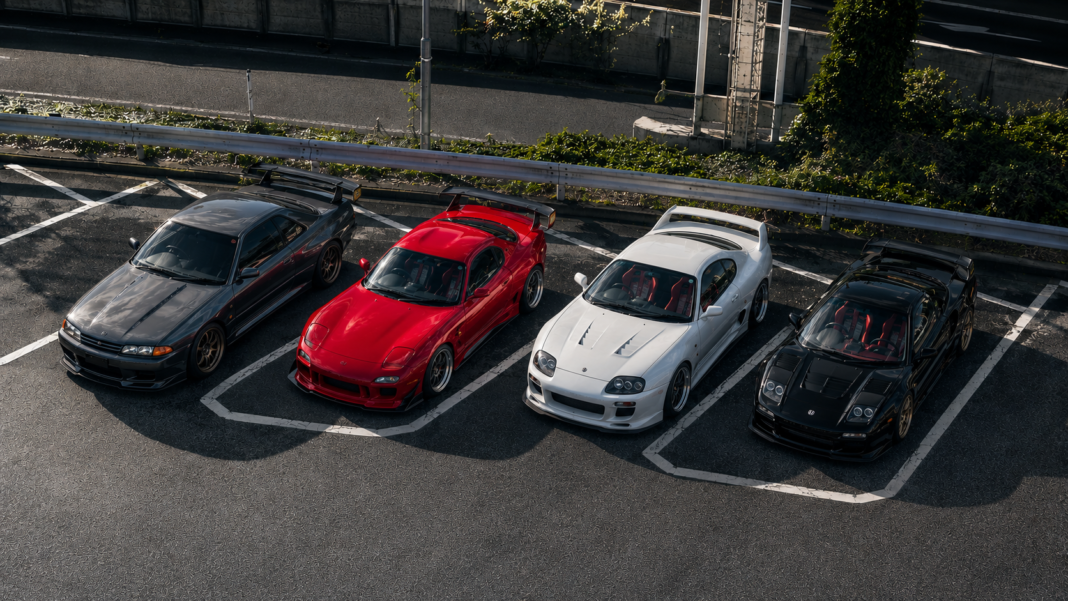
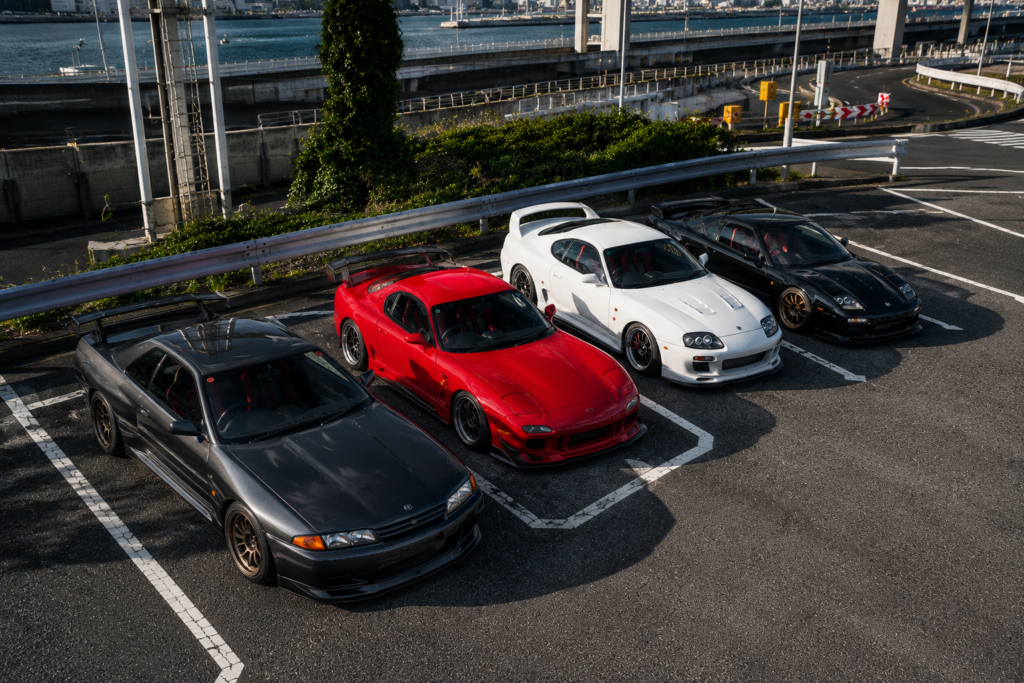
The sun is rising over the Yokohama skyline, casting long shadows across the concrete expanse of the Daikoku Parking Area. This truck stop, located on a man-made island in Tokyo Bay, is a pilgrimage site for car enthusiasts from around the world. On any given Sunday, the lot fills with Nissan GT-Rs, Mazda RX-7s, Toyota Supras, and Honda NSXs. The cars are modified, polished, and driven by people who treat automotive passion as a way of life.
Daikoku is not the only meeting point. There is Tatsumi, there is Umihotaru, there is the Hakone Turnpike. These places are the heart of Japanese car culture, a scene that has shaped performance car enthusiasm globally for more than three decades.
The cars themselves tell a story. The Nissan Skyline GT-R R32, R33, and R34 earned the “Godzilla” nickname by dominating Australian touring car racing. The Mazda RX-7, with its rotary engine, became a legend for its high-revving character and lightweight chassis. The Toyota Supra, with its 2JZ engine, became a tuning icon capable of producing over 1,000 horsepower. The Honda NSX proved that a Japanese supercar could compete with Ferrari.
This article explores why Japanese car culture remains the most influential in the world, from the mountain passes of Gunma to the import scenes of Los Angeles and London.
The Location: Daikoku Parking Area, Yokohama, Japan
Daikoku is a functional space. It is a rest area for truck drivers, not a designed gathering spot. But on weekends, it transforms into a living museum of Japanese automotive history.
The crowd is diverse. There are young men in modified Subaru WRXs, middle-aged businessmen in Porsche 911s, and tourists from Europe and the United States who have traveled thousands of miles to see the cars in their natural habitat.
The atmosphere is electric but orderly. There is no racing, no reckless driving, no drama. The participants park, they talk, they take photos, and they leave.
This is Japanese car culture: passionate, respectful, and deeply knowledgeable.
The Roots: Mountain Passes and Tuning Shops
Japanese car culture grew from two distinct roots.
The first was mountain racing, known as touge. In the 1980s and 1990s, young drivers took their modified cars to the narrow, winding roads of the Gunma mountains. They raced downhill, corner to corner, inch from the guardrails. The sport was dangerous, illegal, and exhilarating. It produced legends like Keiichi Tsuchiya, the “Drift King,” who later inspired the manga and film series Initial D.
The second root was the tuning shop. Companies like HKS, GReddy, and Spoon Sports turned the Honda Civic, the Nissan Silvia, and the Mitsubishi Lancer Evolution into track weapons. These shops developed parts, shared knowledge, and built a community of enthusiasts who valued performance over luxury.
These two roots fed each other. The mountain racers needed parts. The tuning shops needed test drivers. The result was a culture of continuous improvement.
The Golden Era: The 1990s
The 1990s were the golden age of Japanese performance cars. The Japanese economy was strong, and manufacturers were competing fiercely.
Nissan produced the Skyline GT-R R32, R33, and R34, each one more capable than the last. Mazda produced the RX-7 FD, a twin-turbo rotary masterpiece. Toyota produced the Supra MKIV, with the legendary 2JZ engine. Honda produced the NSX, a mid-engine supercar designed with input from Ayrton Senna. Mitsubishi produced the 3000GT and the Lancer Evolution. Subaru produced the Impreza WRX and the 22B.
These cars were not just fast. They were accessible. A young enthusiast could buy a used Japanese performance car, modify it, and compete with cars costing three times as much.
The golden era also produced the manga and film series Initial D, which romanticized mountain racing and introduced a global audience to the cars and the culture.
The Influence on Global Car Culture
Japanese car culture did not stay in Japan. It spread.
In the 1990s and 2000s, imported Japanese cars, known as JDM (Japanese Domestic Market) imports, began appearing in the United States, the United Kingdom, Australia, and New Zealand. Enthusiasts were drawn to the performance, the reliability, and the tuning potential.
The Fast and Furious franchise, released in 2001, brought Japanese car culture to a mainstream audience. The film featured modified Honda Civics, Mitsubishi Eclipses, and Toyota Supras. It was not accurate, but it was influential. A generation of young people discovered Japanese cars through the film.
Today, the JDM import market is a global phenomenon. Older Japanese cars, like the R34 Skyline GT-R and the FD RX-7, sell for six-figure sums at auction. The 25-year import rule in the United States has allowed cars that were previously forbidden to enter the market legally.
The Daikoku Morning: A Conversation with an Import Dealer
A man in his 40s is standing next to a pristine R34 Skyline GT-R V-Spec II. He is an import dealer from California. He comes to Japan several times a year to source cars for his clients.
“I started watching Initial D when I was a kid,” he says. “I fell in love with the cars. Now I sell them to people who did the same.”
He points to a group of young Japanese men standing near a modified Nissan Silvia. “They are the next generation. They are modifying cars, racing on the touge, keeping the culture alive.”
The Engines: The Soul of the Cars
The engines in Japanese performance cars are legendary.
The Nissan RB26DETT, a 2.6 liter twin-turbo inline-six, was used in the Skyline GT-R. It was capable of producing over 1,000 horsepower with modifications.
The Toyota 2JZ GTE, a 3.0 liter twin-turbo inline-six, was used in the Supra. It was known for its robust cast-iron block and its ability to handle extreme boost.
The Mazda 13B-REW, a 1.3 liter twin-turbo rotary, was used in the RX-7. It was small, lightweight, and high-revving. It was also finicky and fuel hungry, which added to its mystique.
The Honda C30A, a 3.0 liter naturally aspirated V6, was used in the NSX. It was designed with titanium connecting rods and a high redline. It was a supercar engine.
These engines were not just powerful. They were distinctive. They had character. They sounded different. They felt different. They became characters in the story of the cars.
The Daikoku Conversation: The Next Generation
The young Japanese men near the Nissan Silvia are in their 20s. They grew up playing Gran Turismo and watching Initial D. They are continuing the tradition.
One of them speaks English. He explains that he bought his Silvia for 500,000 yen, about $3,500. He has spent twice that on modifications.
“I do not care about new cars,” he says. “They are too expensive. They have too many computers. I want to feel the road.”
He will drive his Silvia on the Hakone Turnpike tonight. He will push it to the limit. He will not crash.
The Influence on Modern Supercars
Japanese car culture influences modern supercar design.
The Nissan GT-R R35, introduced in 2007, was a technological tour de force. It used a twin-turbo V6, a dual-clutch transmission, and an advanced all-wheel drive system. It was faster than cars costing three times as much. It embodied the Japanese philosophy of accessible performance.
The Honda NSX, reintroduced in 2016, used a twin-turbo V6 with three electric motors. It was a hybrid supercar that prioritized handling and balance.
The Toyota Supra, reintroduced in 2019, was developed in partnership with BMW. It was controversial, but it reconnected Toyota with its performance heritage.
These cars are not the same as the legends of the 1990s. They are heavier, more complex, and more expensive. But they carry the spirit.
The Daikoku Sunset
The sun is setting over Yokohama. The cars are leaving Daikoku. The Nissan GT-Rs roar onto the highway. The Mazda RX-7s whine. The Toyota Supras cruise.
The import dealer from California is loading photos onto his laptop. The young Japanese men are heading to the mountains. The tourists are heading back to their hotels.
The parking area empties. The trucks return. The cycle will repeat next weekend.
The Global Legacy
Japanese car culture remains the most influential in the world because it is authentic. It is not manufactured by marketing departments. It is built by enthusiasts who drive their cars, modify their cars, and race their cars.
The culture has spread to every continent. There are JDM clubs in Los Angeles, London, Sydney, and Sao Paulo. There are Initial D fans in countries that have never seen snow.
The influence is not just about the cars. It is about the attitude. Japanese car culture values skill, knowledge, and passion over wealth and status. A teenager in a modified Civic is respected if they can drive. A rich man in a stock Ferrari is not.
That attitude has shaped a generation of enthusiasts.
The Austin, Texas, Connection
Across the Pacific, in Austin, Texas, a similar scene unfolds at the Circuit of the Americas. The cars are different, but the spirit is the same. Enthusiasts gather to drive, to talk, and to share their passion.
The influence of Japanese car culture is visible in every modified Subaru, every swapped-in JDM engine, every drift event.
The culture has crossed oceans and generations.
The Daikoku Verdict
Japanese car culture remains the most influential in the world because it is the source. The touge racing, the tuning shops, the manga, the films, the engines, the cars they all originated in Japan.
The culture has evolved, but it has not been replaced. The young men in the Silvia are continuing a tradition that began before they were born.
The import dealer is selling cars to people who fell in love with them as children.
The tourists are making pilgrimages to see the holy sites.
Key Takeaways
- Japanese car culture grew from mountain racing (touge) and tuning shops, creating a community that valued performance and skill.
- The 1990s golden era produced legendary cars like the Skyline GT-R, Supra, RX-7, and NSX.
- Manga and films like Initial D, as well as The Fast and the Furious franchise, spread Japanese car culture globally.
- The JDM import market has become a global phenomenon, with older cars selling for significant sums.
- Modern supercars from Japanese manufacturers continue to embody the philosophy of accessible performance.
Conclusion
The Daikoku Parking Area is quiet now. The cars are gone. The sun has set.
But next weekend, they will return. The Skylines will roar. The RX-7s will whine. The Supras will cruise.
The culture is not static. It changes with each generation. The cars change. The technology changes. The drivers change.
But the spirit remains. Japanese car culture is built on passion, skill, and respect. It is not about money. It is about the drive.
That is why it remains the most influential in the world. That is why people travel thousands of miles to stand in a truck stop in Yokohama.
They are not just looking at cars. They are connecting to a culture that shaped their lives.
The engine starts. The tires grip. The road unwinds. The legend continues.

