
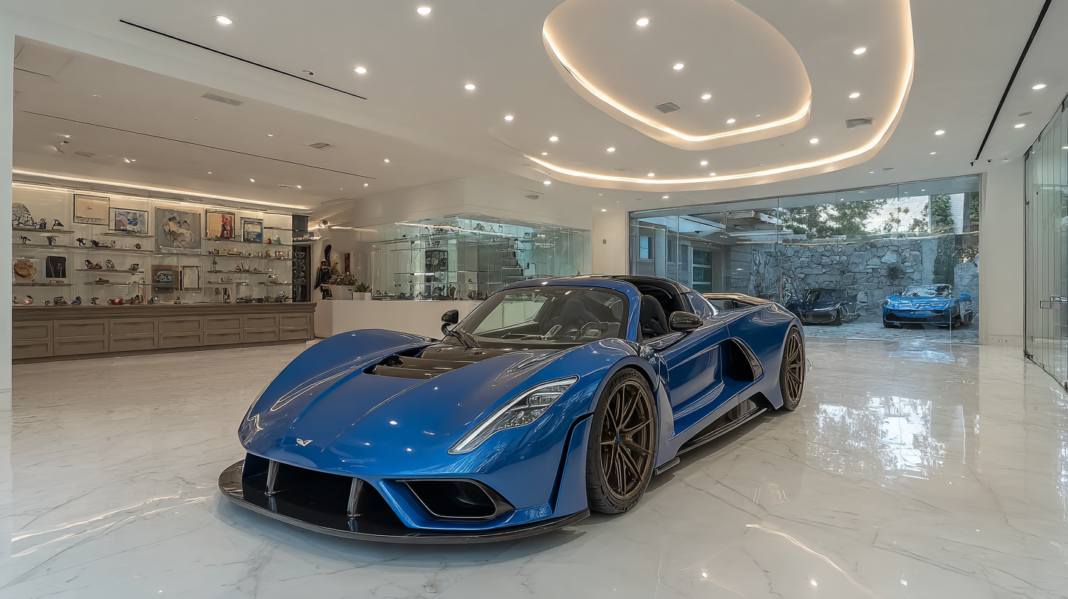
The pursuit of the highest possible speed has driven automotive engineering for more than a century. From the land speed record cars of the 1920s to the hypercars of today, the goal of exceeding 300 miles per hour has remained a constant challenge. Hennessey Performance Engineering, based in Sealy, Texas, has positioned itself at the forefront of this pursuit.
The Venom F5 Roadster is the open-top expression of Hennessey’s top-speed ambition. Following the Venom F5 Coupe, which was engineered to exceed 311 miles per hour, the Roadster takes the same carbon fiber chassis, the same 1,817 horsepower twin-turbocharged V8 engine, and the same aerodynamic philosophy, but removes the roof. The result is a car that promises the fastest open-air driving experience ever offered in a production vehicle.
This article provides a comprehensive examination of the Hennessey Venom F5 Roadster, including its performance specifications, engineering, design, and America’s ongoing pursuit of hypercar speed records.
The Venom F5 Program: A Brief History
The Venom F5 program began with the unveiling of the Coupe. The name F5 refers to the highest rating on the Fujita tornado scale, an appropriate designation for a car designed to generate unprecedented speeds. The Coupe was engineered to reach 311 miles per hour, a figure that would make it the fastest production car in the world.
The development timeline stretched longer than initially anticipated. The Coupe entered production, with all 24 units sold out shortly after the car’s debut. The Roadster was announced, with production scheduled to continue through 2026.
The Roadster shares its fundamental architecture with the Coupe. Hennessey engineered the carbon fiber monocoque from the outset with an open-top version in mind, so only minor adjustments were required to deliver Coupe-rivaling chassis rigidity. This approach ensured that the Roadster would handle as precisely as its fixed-roof sibling.
Powertrain: The Fury V8
Engine Specifications
The Venom F5 Roadster is powered by a 6.6 liter twin-turbocharged V8 engine, designated the Fury. Hennessey designed and built the engine in-house, using high-strength, lightweight components including forged aluminum pistons, forged steel connecting rods, titanium exhaust manifolds, and a billet aluminum intake manifold.
The engine produces 1,817 horsepower at 8,000 rpm and 1,193 lb-ft of torque at 5,000 rpm. The maximum engine speed is 8,200 rpm, with an F5 mode that raises the limit to 8,500 rpm.
Transmission
Power is transmitted to the rear wheels through a seven-speed single-clutch automated gearbox. The single-clutch design is a deliberate choice, prioritizing the mechanical engagement and rapid shift times that enthusiasts value over the smoother operation of dual-clutch units.
The transmission can be operated in fully automatic mode or via paddle shifters mounted on the steering column. The shift times are rapid in the most aggressive drive modes, and the system includes launch control for optimized standing starts.
Cooling and Durability
The engine’s cooling system is engineered for sustained high-speed operation. The car features multiple radiators and heat exchangers to manage the thermal demands of the twin-turbocharged V8. The system is designed to maintain consistent performance during top-speed runs, where the engine operates at maximum output for extended periods.
Performance
Acceleration
Hennessey has not released official acceleration figures for the Roadster, but the Coupe provides a reference point. The Coupe covers the 0 to 62 miles per hour sprint in 2.6 seconds and the 0 to 186 miles per hour sprint in 8.4 seconds. The Roadster, with its slightly higher weight, is expected to achieve similar times.
Top Speed
The Venom F5 Roadster is engineered to exceed 300 miles per hour. This target would make it the fastest production convertible ever built, surpassing the company’s own Venom GT Spyder, which recorded a speed of 265.6 miles per hour.
The Coupe has a claimed top speed of 311 miles per hour, though this figure has not been independently verified. The Roadster’s slightly higher weight and different aerodynamic profile may reduce the top speed marginally, but Hennessey maintains that the car is capable of exceeding 300 miles per hour.
Weight
The Venom F5 Roadster has a dry weight of approximately 3,100 pounds. This is approximately 100 pounds heavier than the Coupe, with the additional weight attributable to the removable roof mechanism and structural reinforcements.
Chassis and Aerodynamics
Carbon Fiber Construction
The Venom F5 Roadster is built around a carbon fiber monocoque chassis, with aluminum alloy subframes and a carbon fiber skin. The monocoque was engineered with variants like the Roadster in mind, so there has been no loss of rigidity or stiffness in the tub.
The body panels are also constructed from carbon fiber, keeping weight to a minimum while providing the structural integrity required for high-speed stability.
Suspension
The car features double wishbone suspension at all four corners, with fully adjustable coil-over dampers. The suspension can be tuned for different driving conditions, from road touring to track use to top-speed runs.
The steering is rack and pinion with electric power assistance. The system is calibrated to provide appropriate weighting and feedback across the car’s speed range.
Brakes
The braking system uses carbon ceramic discs with bespoke six-piston calipers at the front and four-piston calipers at the rear. The front discs measure 390 millimeters in diameter, matching the rear discs. The system is designed to provide consistent stopping power even after repeated high-speed runs.
Wheels and Tires
The Venom F5 Roadster rides on forged aluminum alloy wheels, sized 19 inches at the front and 20 inches at the rear. The wheels feature seven pairs of spokes, each resembling an elongated Hennessey H. The wheels are secured with titanium nuts, a material chosen for its strength, heat tolerance, corrosion resistance, and low mass.
The tires are developed specifically for the Venom F5’s performance requirements. The tires are rated for speeds exceeding 300 miles per hour, a requirement that demanded extensive development from the tire manufacturer.
Aerodynamics
The Venom F5 Roadster’s aerodynamic development focused on managing airflow for stability and cooling. The car features a deep front splitter and broad ducting that channels air underneath the chassis toward an enormous rear diffuser. A small spoiler is mounted between the rear lights, though buyers can specify a larger wing and more aggressive front splitter as optional extras.
The removal of the roof creates aerodynamic challenges that the Coupe does not face. Hennessey’s engineers used computational fluid dynamics to optimize the shape of the windshield and the area behind the seats, managing airflow to reduce drag and minimize buffeting.
The Removable Roof
Design and Construction
The Venom F5 Roadster’s most distinctive feature is its removable carbon fiber roof panel. The single-piece roof is crafted from rigid carbon fiber composites, fully insulated against the elements, and lined with soft Alcantara upholstery.
The roof weighs only 18 pounds, making removal and installation easy for one person. It is secured with four quick-release bolts and a pair of high-strength latches, engineered to withstand the hypercar’s staggering acceleration capabilities and aerodynamic forces at extreme speed.
Storage and Display
Hennessey offers owners a bespoke travel bag for storing the roof panel. For owners who wish to display the roof as a work of art, the company also provides a custom-made sculptural pedestal. The pedestal, crafted in carbon fiber like the roof panel, mirrors design themes from the Venom F5 Roadster.
Engine Viewing Window
A new tempered glass engine viewing window is set directly over the powerplant, spotlighting the Fury V8 engine. The glass panel was developed and certified for use in jet aircraft, capable of withstanding aerodynamic forces exceeding 300 miles per hour and temperatures beyond 1,000 degrees Fahrenheit.
The viewing window is encapsulated within a removable carbon fiber engine cover that features intricately milled heat extraction holes matching those in the rear bumper.
Interior and Driver Focus
Cabin Design
The interior of the Venom F5 Roadster is minimalist but not spartan. The carbon fiber bucket seats and door panels are upholstered in a blend of leather and Alcantara. Creature comforts include air conditioning and an infotainment system with support for Apple CarPlay and Android Auto.
The steering wheel is Formula 1 inspired, with road-going controls for the car’s lights, wipers, ignition, and indicators. Behind the wheel sits a digital instrument cluster, which Hennessey says is based on the head-up display screens fitted to fighter jets.
Drive Modes
The Venom F5 Roadster features five selectable drive modes: Sport, Wet, Drag, Track, and F5. Each mode adjusts the settings of the engine, transmission, suspension, and traction control to suit different driving conditions.
F5 mode is the most extreme, disabling most electronic interventions and allowing the driver full access to the car’s 1,817 horsepower. This mode is intended for top-speed runs on closed courses.
Customization
The Venom F5 Roadster is highly customizable. Buyers may specify any exterior and interior color combination or leave areas of the carbon fiber chassis and body panels exposed. Opting for either a gloss or satin finish allows the woven composite to be appreciated fully.
As a nod to its American heritage, each Venom F5’s door cards feature enamel inserts that depict the Texas and US flags. A toolkit is mounted in the passenger footwell.
Production and Exclusivity
Production Numbers
Hennessey is building 30 units of the Venom F5 Roadster. This is a higher number than the 24-unit Coupe production run, but still extremely limited. Each car is hand-built to the specifications of its owner.
Pricing
The Venom F5 Roadster carries a base price of $3 million. The Coupe was priced at $2.1 million. This pricing places the Roadster in the upper tier of the hypercar market.
Delivery
Production of the Roadster began and continues through 2026. Each car is assembled at Hennessey’s facility in Sealy, Texas, and owners are invited to visit the factory during construction.
How the Venom F5 Roadster Stacks Up Against Rivals
Against the Bugatti Chiron Super Sport
The Bugatti Chiron Super Sport is a 1,600 horsepower, 8.0 liter quad-turbocharged W16 hypercar with a top speed of 273 miles per hour. The Chiron has proven its capability with independently verified speed records.
The Chiron’s advantage is its proven performance and its luxury. Bugatti’s interior is more opulent, and the car’s engineering has been validated through extensive testing.
The Venom F5 Roadster’s advantage is its power-to-weight ratio and its open-air experience. With 1,817 horsepower and a weight of 3,100 pounds, the Venom has a superior power-to-weight ratio. The removable roof also provides an experience that the Chiron cannot match.
Against the Koenigsegg Jesko Absolut
The Koenigsegg Jesko Absolut is designed as a low-drag top-speed specialist, with a 5.0 liter twin-turbocharged V8 producing 1,600 horsepower on standard fuel. Koenigsegg claims a top speed exceeding 330 miles per hour.
The Jesko’s advantage is its theoretical top speed and its advanced transmission. Koenigsegg’s Light Speed Transmission is one of the most sophisticated gearboxes in the industry.
The Venom F5 Roadster’s advantage is its American engineering and its open-air design. The Venom is a more visceral car, with a focus on driver engagement and the experience of speed.
Against the SSC Tuatara
The SSC Tuatara is an American hypercar with a 5.9 liter twin-turbocharged V8 producing 1,750 horsepower. The Tuatara claimed a top speed record, though the record was later disputed.
The Tuatara’s advantage is its established presence in the hypercar market. The car has been in production for several years and has a proven track record.
The Venom F5 Roadster’s advantage is its higher power output and its convertible configuration. With 1,817 horsepower, the Venom produces 67 more horsepower than the Tuatara, and the removable roof provides a unique experience.
Against the Czinger 21C
The Czinger 21C is a hybrid hypercar with a 2.9 liter twin-turbocharged V8 and two electric motors producing a combined 1,250 horsepower. The car features a tandem seating arrangement and a top speed of 253 miles per hour.
The 21C’s advantage is its innovative manufacturing process and its hybrid technology. The car’s 3D-printed components and AI-designed structures represent a new approach to automotive engineering.
The Venom F5 Roadster’s advantage is its pure internal combustion character and its top-speed focus. The Venom’s 1,817 horsepower V8 provides a sensory experience that the hybrid 21C cannot match.
The Pursuit of 300 Miles Per Hour
The Challenge
Exceeding 300 miles per hour in a production car presents extraordinary engineering challenges. Aerodynamic forces increase with the square of speed, meaning that the difference between 250 and 300 miles per hour is not 20 percent but 44 percent. Cooling requirements, tire technology, and structural integrity all become more demanding at these speeds.
The Record
The current production car top speed record is held by a pre-production prototype. Hennessey claims that the Venom F5 Coupe is capable of exceeding 311 miles per hour, which would surpass that record. The Roadster’s 300 miles per hour target would make it the fastest convertible in production.
Verification
Independent verification of top-speed records is essential for credibility. Hennessey has not yet conducted an official top-speed run with the Venom F5, and the car’s claimed capabilities remain theoretical. The company has stated that validation of the model’s high-speed capabilities will occur as production continues.
The Hennessey Story
From Tuner to Manufacturer
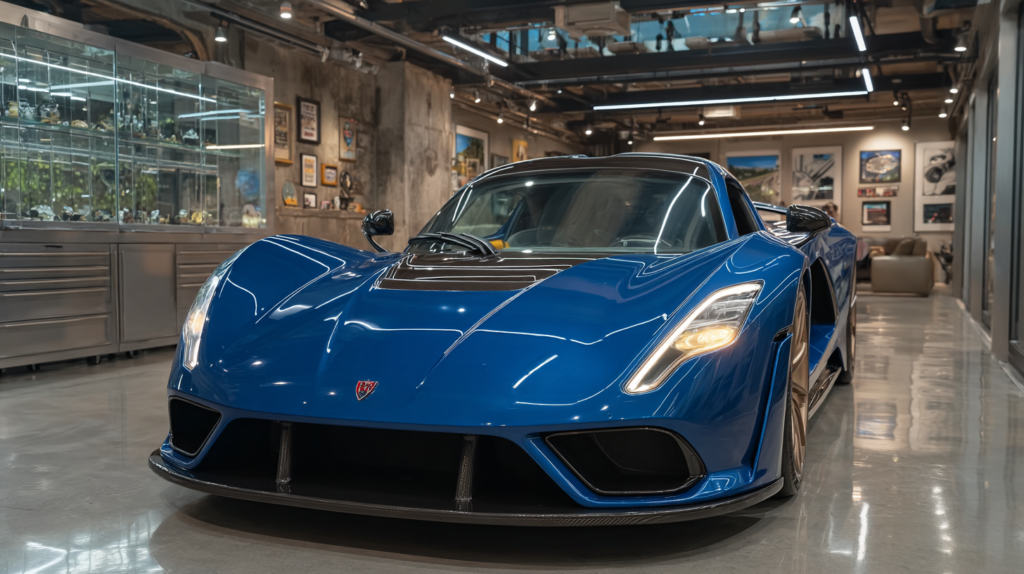
Hennessey Performance Engineering was founded by John Hennessey, a former racer and automotive enthusiast who began modifying cars in the 1990s. The company grew from a small tuning shop into one of the most respected names in high-performance automotive engineering.
The Venom GT, introduced in 2011, marked Hennessey’s transition from tuner to manufacturer. Built around a lightweight carbon fiber chassis with a twin-turbocharged V8 engine, the Venom GT set a production car speed record. It established Hennessey as a legitimate competitor to established European hypercar manufacturers.
The Venom F5 represents the culmination of this journey. It is a clean-sheet design, with a carbon fiber monocoque, an aerodynamically optimized body, and a 6.6 liter twin-turbocharged V8 engine. It is a car that represents the American pursuit of speed.
Specifications Summary
| Specification | Value |
|---|---|
| Engine | 6.6L twin-turbocharged V8 |
| Horsepower | 1,817 hp at 8,000 rpm |
| Torque | 1,193 lb-ft at 5,000 rpm |
| Redline | 8,200 rpm (8,500 rpm F5 mode) |
| Transmission | 7-speed single-clutch automated |
| Drive | Rear wheel drive |
| 0-62 mph | 2.6 seconds (Coupe figure) |
| Top Speed | 300+ mph (engineered target) |
| Weight | 3,100 lb dry |
| Production | 30 units |
| Base Price | $3 million |
Conclusion
The Hennessey Venom F5 Roadster represents the American pursuit of speed at its most extreme. It is a 1,817 horsepower, 300 miles per hour open-top hypercar, engineered in Texas and built for drivers who want the fastest possible experience. Its 6.6 liter twin-turbocharged V8, carbon fiber construction, and removable roof panel make it one of the most extreme production cars ever built.
The Venom F5 Roadster is not a car for everyone. Its production is limited to 30 units, its price is $3 million, and its focus on top-speed performance means it lacks the luxury of some competitors. But for the 30 owners who will acquire a Roadster, the car offers something that no other vehicle can provide: the experience of driving the fastest open-top production car ever built.
The Venom F5 Roadster also represents the culmination of John Hennessey’s vision. From a small tuning shop in Texas to a manufacturer of world-class hypercars, Hennessey has demonstrated that American engineering can compete at the highest level. The Venom F5 Roadster is a statement of that capability.
As the automotive industry continues its transition toward electrification, the Venom F5 Roadster stands as a celebration of what internal combustion can still achieve. It is a car that prioritizes speed, engagement, and the visceral experience of driving. It is a fitting continuation of the American pursuit of speed, and it stands as one of the most extreme hypercars ever built.

