
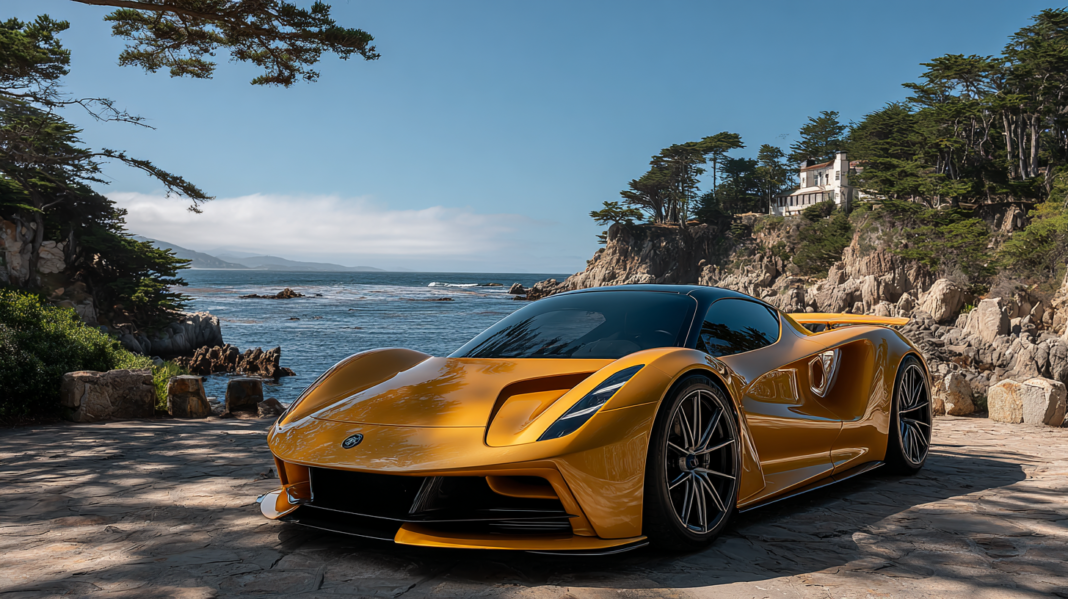
The Lotus Evija represents a significant moment in automotive history. It is the first fully electric vehicle from the British manufacturer, and it is also the most powerful production car Lotus has ever built. With 1,973 horsepower from four electric motors, a carbon fiber monocoque, and a design that prioritizes aerodynamic efficiency, the Evija is a statement of intent for a brand that is reinventing itself for the electric era.
First unveiled in 2019, the Evija has taken years to bring to production. The challenges of developing a 2,000 horsepower electric hypercar are substantial, and Lotus’s small engineering team faced delays as it worked to perfect the car’s powertrain, cooling system, and chassis. Now, as customer deliveries begin, the Evija stands as one of the most extreme and technologically advanced hypercars ever built.
This article provides a comprehensive review of the Lotus Evija, examining its performance specifications, electric powertrain, design philosophy, and what it represents for the future of Lotus performance engineering.
The Evija Name: A New Beginning
The name Evija is derived from the name Eve, meaning the first or the beginning. It is a fitting choice for a car that represents a new chapter for Lotus. The company, known for lightweight sports cars like the Elise, Exige, and Evora, is transitioning to an all electric future. The Evija is the halo car for this transition, a demonstration of what Lotus can achieve when given the freedom to create without compromise.
The Evija is also a tribute to Lotus’s founder, Colin Chapman. Chapman’s philosophy of “simplify, then add lightness” has guided the brand for decades. The Evija honors this philosophy through its carbon fiber construction, its focus on aerodynamic efficiency, and its commitment to driver engagement.
Powertrain: Four Motors, 2,000 Horsepower
Motor Configuration
The Evija is powered by four electric motors, one mounted at each wheel. This quad motor configuration provides all wheel drive and enables sophisticated torque vectoring capabilities. By varying power delivery to individual wheels, the system can enhance cornering performance, rotating the car into turns and providing optimal traction during exit.
Each motor produces approximately 493 horsepower, for a total system output of 1,973 horsepower. The torque figure is 1,254 lb ft, a staggering number that contributes to the car’s acceleration.
Battery and Range
Power for the electric motors is drawn from a 70 kWh battery pack, mounted low in the chassis to lower the center of gravity. The battery is designed for power delivery rather than range, with a focus on providing the current necessary for the car’s 2,000 horsepower output.
The estimated range is approximately 215 miles on the WLTP cycle. This figure is lower than many electric vehicles, but it is appropriate for a hypercar designed for performance rather than long distance touring.
Charging
The Evija features 800 volt charging capability, allowing it to charge at up to 350 kW. Under ideal conditions, a 10 to 80 percent charge can be completed in approximately 18 minutes. This charging speed makes longer journeys practical, though the car’s primary mission is clearly performance.
Performance
Acceleration and Speed
The Evija accelerates from 0 to 60 miles per hour in under 3.0 seconds. The 0 to 186 miles per hour sprint takes approximately 9.0 seconds. The quarter mile is completed in approximately 9.0 seconds.
Top speed is rated at 200 miles per hour, a figure that is limited by the car’s aerodynamic profile and the gearing of the transmission.
Weight and Balance
The Evija has a dry weight of approximately 3,700 pounds. This figure includes the battery pack, the four motors, and the carbon fiber structure. The weight distribution is optimized for handling, with the battery mounted low to maintain a low center of gravity.
Chassis and Aerodynamics
Carbon Fiber Monocoque
The Evija is built around a carbon fiber monocoque, providing exceptional rigidity and occupant protection while minimizing weight. The monocoque is manufactured using aerospace grade materials and processes, with careful attention to fiber orientation and layup sequence.
The body panels are also carbon fiber, and the entire structure is designed to be as light as possible while maintaining the necessary strength for a 2,000 horsepower hypercar.
Suspension
The Evija features double wishbone suspension at all four corners, with pushrod actuated dampers. The suspension is adjustable, with settings for compression and rebound that can be tuned to suit different tracks and conditions.
Aerodynamics
The Evija’s aerodynamic development focused on managing airflow for downforce and cooling. The car features a prominent front splitter, a rear diffuser, and a large rear wing that deploys at speed. The system generates substantial downforce, keeping the car planted at high speeds.
The most distinctive aerodynamic feature of the Evija is its rear venturi tunnels. These tunnels, which run through the rear of the car, accelerate airflow beneath the car and generate downforce without the drag penalty of a traditional wing. The tunnels are a design element that references Lotus’s racing heritage.
Cooling
The Evija’s cooling system is one of its most complex engineering achievements. The car features multiple radiators and heat exchangers to manage the thermal demands of the four electric motors and the battery pack. The system is designed to maintain consistent performance during sustained track use.
Design
Exterior Styling
The Evija’s exterior design is dramatic and functional. The front end features a prominent grille and large air intakes that feed cooling air to the battery and motors. The headlights are slim and integrated into the bodywork.
The side profile shows the mid engine proportions, with a long wheelbase, short overhangs, and a cabin positioned forward of the rear axle. The doors open upward in a scissor configuration, providing access to the cabin and adding to the car’s dramatic presence.
The rear end is dominated by the venturi tunnels, which are integrated into the bodywork and illuminated with LED lighting. The rear wing deploys from the bodywork at speed, and the diffuser spans the width of the car.
Interior Design
The interior of the Evija is focused on the driver. The seats are carbon fiber racing buckets with Alcantara upholstery, providing lateral support during cornering. The dashboard features a digital instrument cluster that can be configured to display performance data, and a central touchscreen handles infotainment functions.
The steering wheel is flat bottom, with integrated controls for the car’s systems. The paddle shifters are mounted on the steering column, controlling the regenerative braking levels.
The interior is stripped back compared to luxury focused hypercars, with a focus on function over opulence. The materials are of high quality, but the emphasis is on weight reduction and driver engagement.
Driving Experience
On Road Character
The Evija is a car that is surprisingly civilized for a 2,000 horsepower hypercar. The electric motors provide instant torque, but the power delivery is smooth and progressive. The suspension, while firm, is not punishing. The cabin is quiet, with only the whine of the motors and the rush of air providing auditory feedback.
The car can be driven in electric only mode, as all hypercars are electric, but the Evija’s range is sufficient for short journeys. The car is not designed for long distance touring; it is designed for performance.
On Track Behavior
When driven on a track, the Evija reveals the depth of its engineering. The brakes provide consistent stopping power lap after lap, with the regenerative system capturing energy during deceleration. The chassis remains composed through corners, with the torque vectoring system managing power delivery to maximize grip.
The car’s quad motor configuration allows for independent control of each wheel, providing a level of agility that mechanical systems cannot match. The Evija can rotate on corner entry, hold a neutral line through the apex, and put power down on exit with precision.
The Sound
The Evija does not attempt to fake the sound of a combustion engine. Instead, it offers the characteristic whine of its electric motors under load, the rush of air over the bodywork, and the protest of tires at the limit. For drivers who value the sensory aspects of driving, this soundscape provides its own form of feedback.
Production and Rarity
Production Numbers
Lotus is building 130 units of the Evija, a number that was determined by the demand from collectors and the capacity of the company’s workshop. Each car is hand built to the specifications of its owner, with extensive personalization options available.
Pricing
The Evija carries a base price of approximately $2.3 million. This pricing places it in the upper tier of the hypercar market, above the Rimac Nevera and below the Bugatti Bolide.
Delivery and Ownership
Evija owners participate in a structured delivery program, with Lotus providing support and track events. The cars are hand built at Lotus’s headquarters in Hethel, England, and each owner is invited to visit the factory during construction.
The Future of Lotus
Electrification Strategy
The Evija is the first step in Lotus’s electrification strategy. The company has announced that it will transition to an all electric lineup by 2028, with new models including the Eletre SUV and the Emeya four door coupe.
The Evija serves as a halo car for this transition, demonstrating Lotus’s engineering capabilities and setting the stage for future models.
Performance Engineering
The lessons learned from the Evija’s development will inform future Lotus models. The quad motor torque vectoring system, the advanced cooling technology, and the carbon fiber construction techniques will all filter down to more accessible vehicles.
For enthusiasts who have followed Lotus’s journey from the Elise to the Evija, the future is promising. The company that built lightweight sports cars for decades is now applying its expertise to electric hypercars, and the Evija is proof that the philosophy of “simplify, then add lightness” can be translated into the electric era.
How the Evija Stacks Up Against Rivals
Against the Rimac Nevera
The Rimac Nevera is the Evija’s most direct competitor, with a four motor powertrain producing 1,914 horsepower.
The Nevera’s advantage is its proven performance. The Rimac has been independently tested and validated, with a 0 to 60 time of 1.85 seconds and a top speed of 258 mph.
The Evija’s advantage is its design and its heritage. The Lotus is a more beautiful car, with a design that references the brand’s racing history. The Evija also benefits from Lotus’s expertise in lightweight construction and chassis tuning.
Against the Lotus Evija
The comparison with the Nevera is inevitable, but the Evija offers a different experience. The Lotus is more focused on driver engagement, with a chassis that communicates more clearly and a design that prioritizes aerodynamics over outright numbers.
Against the Pininfarina Battista
The Pininfarina Battista is an electric hypercar with a four motor powertrain producing 1,900 horsepower.
The Battista’s advantage is its design. Pininfarina’s styling is among the most beautiful in the industry, and the Battista is a rolling sculpture.
The Evija’s advantage is its engineering. Lotus’s expertise in lightweight construction and chassis tuning gives the Evija a level of agility that the Battista cannot match.
Against the Aspark Owl
The Aspark Owl is an electric hypercar with a four motor powertrain producing 2,012 horsepower.
The Owl’s advantage is its acceleration. The Aspark has claimed a 0 to 60 time of 1.7 seconds, making it one of the quickest production cars ever built.
The Evija’s advantage is its overall balance. The Lotus is a more complete car, with better handling, more sophisticated aerodynamics, and a more refined interior.
Specifications Summary
| Specification | Value |
|---|---|
| Motors | 4 motors (1 per wheel) |
| Horsepower | 1,973 hp |
| Torque | 1,254 lb ft |
| Battery | 70 kWh |
| Range | 215 miles (WLTP) |
| 0-60 mph | Under 3.0 seconds |
| 0-186 mph | 9.0 seconds |
| Top Speed | 200 mph |
| Weight | 3,700 lb dry |
| Production | 130 units |
| Base Price | $2.3 million |
Conclusion
The Lotus Evija represents a significant achievement for the British manufacturer. It is the first fully electric vehicle from Lotus, and it is the most powerful production car the company has ever built. With 1,973 horsepower from four electric motors, a carbon fiber monocoque, and a design that prioritizes aerodynamic efficiency, it is a car that honors the brand’s heritage while embracing the future.
The Evija is not a car for everyone. Its production is limited to 130 units, its price is $2.3 million, and its focus on performance means it lacks the luxury of some competitors. But for the 130 owners who will acquire an Evija, the car offers something that no other vehicle can provide: the experience of driving a Lotus hypercar, a machine that represents the pinnacle of the brand’s engineering.
The Evija also represents the future of Lotus. It is a statement of intent, a demonstration that the company can compete at the highest level of the hypercar market. For enthusiasts who have followed Lotus’s journey from the Elise to the Evija, the future is bright.
The Lotus Evija stands as one of the most extreme and technologically advanced hypercars ever built. It is a fitting tribute to Colin Chapman’s legacy, and it is a sign that the spirit of Lotus lives on in the electric era.

