
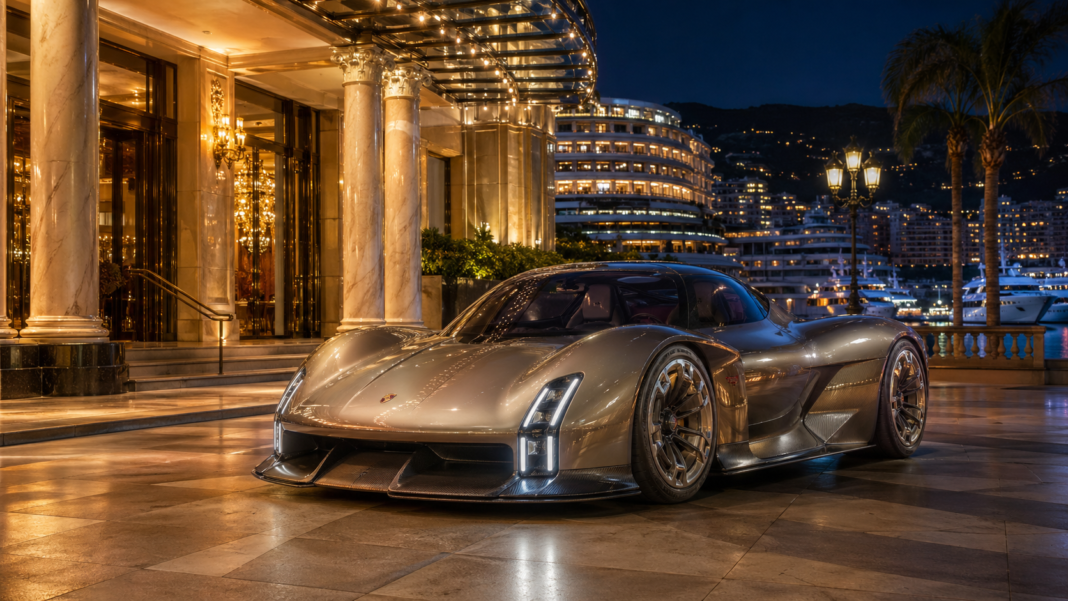
The Porsche Mission X represents the future of the hypercar. First unveiled to celebrate Porsche’s 75th anniversary, this all-electric concept study stands in the direct lineage of the 959, Carrera GT, and 918 Spyder. It is a statement of intent, a demonstration that Porsche envisions the electric hypercar not as a compromise but as the next evolution of extreme performance.
As we move through 2026, the automotive world awaits a final production decision from Porsche. If given the green light, the Mission X would target the Nürburgring production car lap record, achieve a power-to-weight ratio of one horsepower per kilogram, generate downforce exceeding the current 911 GT3 RS, and charge significantly faster than the Taycan Turbo S. This article explores the design philosophy, engineering goals, and the significance of this ambitious project.
The Lineage: Inheritors of a Legacy
The Mission X positions itself as the successor to three of Porsche’s most significant supercars.
The 959 was the most technologically advanced car of its era. It introduced a sequential twin-turbocharged engine, electronically controlled all-wheel drive, and adjustable suspension. It was the fastest production car in the world at its debut.
The Carrera GT represented a return to purism. With its 5.7 liter naturally aspirated V10, carbon fiber monocoque, and six-speed manual transmission, it prioritized driver engagement above all else. It remains one of the most revered driver’s cars ever built.
The 918 Spyder was the pioneer of the hybrid hypercar. It combined a 4.6 liter V8 with two electric motors to produce 887 horsepower. It was one of the first production cars to lap the Nürburgring in under seven minutes.
The Mission X inherits the ambition of the 959, the driver focus of the Carrera GT, and the technological sophistication of the 918 Spyder. It is designed to be the next milestone in this lineage.
Exterior Design: Sculpted Performance
The Mission X is visually striking. It measures approximately 4.5 meters long, 2 meters wide, and stands less than 1.2 meters tall, giving it the compact proportions of the Carrera GT and 918 Spyder.
Proportions and Stance
The car sits low and wide, with a wheelbase of approximately 2.73 meters. The design is lean and muscular, with smooth surfaces and subtle curves. The bodywork below the waistline is finished in exposed carbon fiber, while the upper surfaces are painted in a metallic finish. The combination of the long hood, the fastback tail, and the prominent fenders gives the Mission X an aggressive yet elegant stance.
Lighting Signature
The Mission X features a reimagined version of Porsche’s classic four-point light graphic. The vertical headlights, inspired by the 906 and 908 race cars, are housed in a high-tech framework with exposed LED modules. At the rear, a full-width light unit spans the tail, with transparent, illuminated Porsche lettering. When the car is charging, the “E” in the Porsche logo pulses, creating a subtle, futuristic effect.
Le Mans Doors
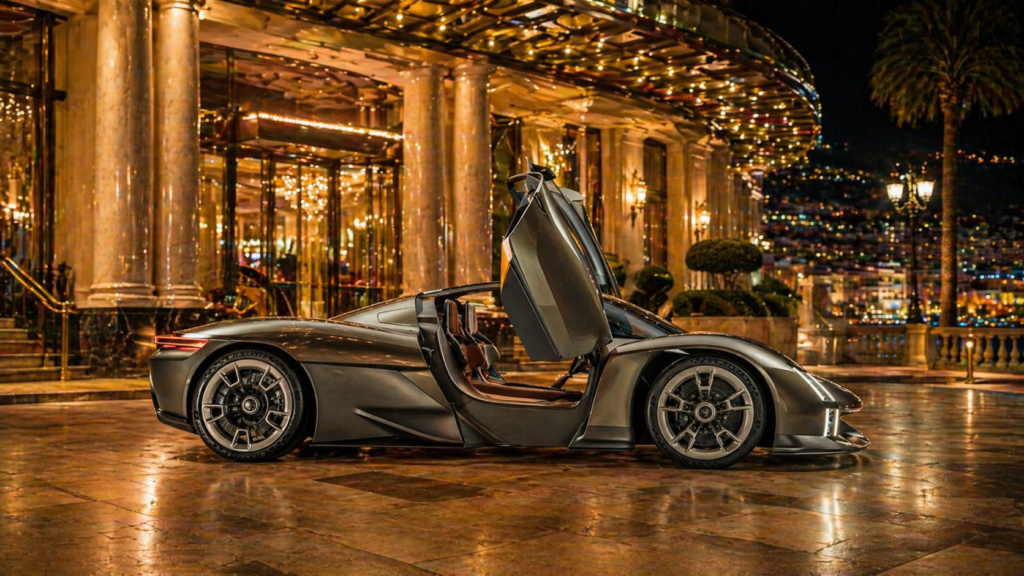
One of the most distinctive features is the Le Mans-style door. Attached to the A-pillar and the roof, these doors open upwards and forwards. This design, previously used on the legendary Porsche 917 race car, provides wide access to the cabin and adds to the car’s dramatic presence.
Aerodynamic Details
The concept is covered in functional aerodynamic elements. The rear wheels are fitted with near-transparent aeroblades designed like turbines to improve brake cooling. The lightweight glass dome features a carbon fiber-reinforced exoskeleton that extends over both seats. The car is equipped with an active aero system, allowing the front splitter and rear wing to adjust automatically based on speed and driving mode.
Interior Design: The Driver as the Center
The interior of the Mission X is asymmetrical and entirely focused on the driver.
Asymmetrical Concept
The driver’s seat is finished in a light grey and forms a single visual unit with the center console and the dashboard. The passenger seat is finished in a contrasting brown. This color scheme emphasizes that the Mission X is built for the driver, not the passenger.
Motorsport Elements
The carbon fiber seat shells are integrated into the monocoque, and the car features six-point seatbelts. The steering wheel is a motorsport-derived open-top design with mode switches and shift paddles. There is a recording button on the multi-purpose controller that allows the driver to capture video footage from onboard cameras.
The Chronograph Module
A removable chronograph module can be docked into the passenger side dashboard. It features both analog and digital displays and can show lap times or vital driver data for circuit and rally use.
Engineering Goals: The Technical Vision
Porsche has not released detailed powertrain specifications for the Mission X. Instead, the company has outlined a “technical vision” that establishes the targets a production car must meet.
Nürburgring Record
The primary goal is for the Mission X to be the fastest road-legal vehicle around the Nürburgring Nordschleife. The current lap record is held by a hypercar with a Formula 1 derived powertrain. The Mission X is designed to beat this time.
Power-to-Weight Ratio
The target is a power-to-weight ratio of approximately one horsepower per kilogram. This implies a vehicle weight of roughly 1,500 kilograms and an output of approximately 1,500 horsepower.
Downforce
The Mission X is designed to generate downforce “well in excess” of the current 911 GT3 RS. The GT3 RS generates approximately 860 kilograms of downforce at high speed. The Mission X would exceed this figure, providing exceptional high-speed cornering grip.
Charging Performance
The car will use a high-voltage architecture, enabling significantly faster charging than current models. The goal is for the Mission X to charge approximately twice as quickly as the Taycan Turbo S, which can charge at high power levels. This suggests a target charging power approaching 500 kW.
High-Voltage Architecture
The high-voltage system is a cornerstone of the Mission X’s engineering. It allows for higher charging speeds and reduced current, which translates to thinner, lighter wiring and improved thermal efficiency.
The E-Core Layout
The Mission X uses an “e-core layout.” The battery pack is mounted centrally behind the seats, rather than being spread across the floor as in a traditional skateboard chassis.
This configuration has several advantages. It centers the mass of the car, providing the same weight distribution benefits as a traditional mid-engine sports car. It positions the driver and passenger lower in the chassis, lowering the overall center of gravity. It also makes the car more agile and responsive than a battery-skateboard design.
Development Status and Production Potential
Current Status
As of 2026, the Mission X remains a concept. Porsche continues to evaluate the feasibility of bringing the car to production. A final decision has not yet been announced.
Challenges
There are significant engineering challenges to overcome. Keeping the weight down to 1,500 kilograms while delivering 1,500 horsepower and a large enough battery requires advancements in battery energy density and thermal management. The high-voltage architecture is complex and requires new components that must be reliable and safe. The cost of developing a bespoke hypercar platform is immense, and Porsche must determine if there is sufficient market demand at the expected price point.
Expected Timeline
If the Mission X is approved for production, its release would likely follow the timeline of the Mission E concept, which was shown in 2015 and led to the production Taycan in 2019. A similar timeline would place the Mission X in production around 2027 or 2028.
Exclusivity and Pricing
Production would be extremely limited, likely to a few hundred units. The price would be significant, likely exceeding $2 million. The Mission X would be reserved for Porsche’s most dedicated collectors and enthusiasts.
The Modernized Porsche Crest
The Mission X debuted a modernized version of the Porsche crest. The new crest features a more minimalist design, with a brushed precious metal appearance, a honeycomb structure, and a more stylized animal motif. It is cleaner and more sophisticated, reflecting Porsche’s modern brand identity. The crest appears on the front hood and steering wheel of the Mission X, and in a monochromatic version on the wheel centers.
The Mission X and the Future of Porsche
The Mission X is not just about building a hypercar. It is a technology demonstrator for the entire Porsche brand.
Technology Transfer
The high-voltage architecture, the advanced battery cooling, the lightweight materials, and the aerodynamic concepts developed for the Mission X are expected to trickle down to future production models.
The All-Electric Strategy
Porsche has committed to an all-electric future. The Mission X is the halo car for this vision. It is designed to prove that electric cars can be the most exciting, most capable, and most desirable performance machines in the world.
The Successor to the 918 Spyder
The Mission X is the hypercar that will succeed the 918 Spyder. It will set a new benchmark for performance and technology.
How the Mission X Stacks Up Against Rivals
Against the Mercedes-AMG One
The Mercedes-AMG One is a hypercar with a Formula 1-derived V6 hybrid producing over 1,000 horsepower.
The One’s advantage is its F1 powertrain and its engine character. The Mercedes’ engine revs to very high rpm and produces a sound that is pure racing.
The Mission X’s advantage is its all-electric powertrain and its charging technology. The Porsche’s electric motors provide instant torque, and its high-voltage architecture allows for rapid charging.
Against the Rimac Nevera
The Rimac Nevera is an all-electric hypercar with nearly 2,000 horsepower.
The Nevera’s advantage is its power and its proven performance.
The Mission X’s advantage is its lightweight construction and its Porsche engineering. The Porsche is expected to be significantly lighter and more agile than the Nevera.
Against the Ferrari SF90 Stradale
The Ferrari SF90 Stradale is a plug-in hybrid with nearly 1,000 horsepower.
The SF90’s advantage is its V8 engine and its brand prestige.
The Mission X’s advantage is its all-electric efficiency and its track focus.
Specifications Summary
| Specification | Target |
|---|---|
| Length | Approximately 4.5 meters |
| Width | Approximately 2.0 meters |
| Height | Under 1.2 meters |
| Wheelbase | Approximately 2.73 meters |
| Weight | Approximately 1,500 kg |
| Power-to-Weight Ratio | Approximately 1 hp per kg |
| Power | Approximately 1,500 hp |
| Downforce | Exceeds 911 GT3 RS (860+ kg) |
| Charging Architecture | High voltage |
| Charging Speed | Approximately 2x Taycan Turbo S |
| Nürburgring Target | Under current record |
Conclusion
The Porsche Mission X is a vision of the future. It is a hypercar that honors the legacy of the 959, Carrera GT, and 918 Spyder, while embracing an all-electric future. Its design is stunning, its engineering goals are ambitious, and its potential is immense.
The Mission X is not a production car, at least not yet. As of 2026, the decision to build it remains under evaluation. But the concept stands as a statement of Porsche’s intent. It says that the hypercar will survive the transition to electric power. It says that the electric sports car can be the fastest, most exciting, and most desirable car in the world.
If the Mission X reaches production, it will do for the electric hypercar what the 959 did for all-wheel drive, the Carrera GT did for carbon fiber, and the 918 did for hybridization. It will set a new standard.
The Porsche Mission X is a dream made real. It is a glimpse of the next hypercar. And it is a promise that the future of performance is electric.

