
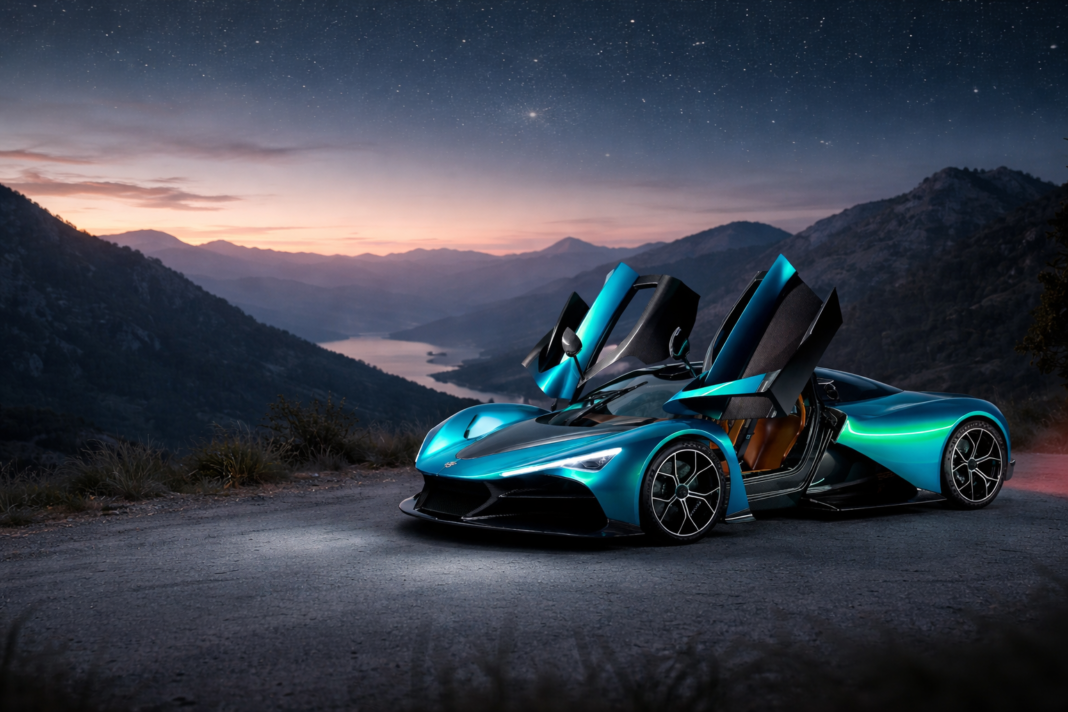
The world of hypercars is populated by names that carry decades of weight. Ferrari, Lamborghini, Bugatti these are brands with histories stretching back generations, their reputations built on countless victories and iconic designs. But every so often, a new player arrives from an unexpected corner of the world, determined to challenge the established order with fresh thinking and uncompromising ambition.
Zenvo, a small Danish manufacturer based in Præstø, is such a player. Since its founding in 2004, the company has pursued a singular vision: to create extreme, limited production performance machines that combine Scandinavian design sensibility with engineering that pushes boundaries. The TSR series, with its aggressive V8 power and track focused demeanor, established Zenvo’s credentials among enthusiasts who value rarity and raw performance.
The Aurora, revealed in 2023 and now entering production in 2026, represents a quantum leap for the brand. Named for the ethereal light phenomenon of the aurora borealis, this hypercar is Zenvo’s first hybrid model and its most ambitious project to date. Developed in partnership with a leading British engineering firm, the Aurora introduces an all new V12 engine, advanced electrification, and a choice of two distinct variants tailored to different driving priorities.
With production limited to just 100 units worldwide, split evenly between the track focused Agil and the grand touring Tur, the Aurora is a machine built for collectors who seek something truly extraordinary. This article provides a detailed examination of the Zenvo Aurora, its performance specifications, design philosophy, and what makes this car stand out in 2026.
The Zenvo Approach
A Philosophy of Extremes
Zenvo’s approach to the Aurora project was guided by a clear philosophy: pursue the absolute best possible driver’s car without being constrained by target numbers or competitor benchmarks. The company’s leadership has stated that during development, it was important not to chase specific figures or lap times. The goal was simply to build an uncompromising vehicle for drivers, one that would excel on every level.
This philosophy meant starting from a clean sheet of paper. Rather than adapting existing components or sharing platforms with other manufacturers, Zenvo committed to developing everything from the ground up. The ZM1 modular system, which underpins the Aurora, was designed with structural safety levels comparable to Formula One, providing a foundation capable of handling the immense forces the car would generate.
The Engineering Partnership
A key enabler of the Aurora project was the collaboration with a respected British engineering firm with extensive experience in high performance engine development. Together, Zenvo and its partner created the Mjølner engine, named for Thor’s hammer in Norse mythology. This partnership brought world class engineering resources to bear on Zenvo’s vision, resulting in a powertrain that claims the title of the most powerful V12 ever fitted to a road car.
The company’s leadership noted that a standard system would have been simpler, but it was never an option. The Aurora represents the absence of compromise, and that meant developing a powertrain that exactly matched the company’s vision. Like the car itself, the Mjølner pushes the boundaries of engineering.
The Two Variants: Agil and Tur
The Zenvo Aurora is offered in two distinct configurations, each with its own character and priorities. Both variants share the same basic architecture and the core V12 engine, but their hybrid systems, weight targets, and aerodynamic treatments are tailored to different missions.
Aurora Agil: The Track Weapon
The Agil, meaning agile in Danish, is designed for uncompromising track performance. It features a rear wheel drive configuration with a single electric motor mounted at the rear axle. This motor contributes additional horsepower to the total output, bringing combined system power to approximately 1,470 horsepower and 1,400 Newton meters of torque.
Weight is the priority for the Agil. With a dry mass of just 1,300 kilograms, it is the lightest car Zenvo has ever built. This low weight, combined with the rear drive configuration and a focus on driver involvement, makes the Agil a machine for purists who value connection and feedback over electronic assistance.
The aerodynamic package for the Agil is extreme. At 250 kilometers per hour, it generates 880 kilograms of downforce, pressing the car into the pavement for maximum cornering grip. The result is acceleration from 0 to 100 kilometers per hour in 2.5 seconds, 0 to 200 in 4.6 seconds, 0 to 300 in 10 seconds, and a top speed of 365 kilometers per hour.
Aurora Tur: The Grand Tourer
The Tur, the Danish word for tour, takes a different approach. It is designed to combine breathtaking performance with the comfort and refinement expected of a grand touring hypercar. The Tur adds two additional electric motors at the front axle, creating an all wheel drive system that delivers staggering traction and acceleration.
Total output for the Tur reaches approximately 1,850 horsepower and 1,700 Newton meters of torque. Despite its higher weight of 1,450 kilograms, the Tur is significantly faster than the Agil in a straight line, thanks to its additional power and all wheel drive traction. It accelerates from 0 to 100 kilometers per hour in just 2.3 seconds, reaches 300 in 9 seconds, and can achieve a top speed of 450 kilometers per hour.
The Tur’s aerodynamic treatment is less aggressive than the Agil’s, prioritizing low drag for high speed runs rather than maximum downforce. It can reach 400 kilometers per hour in just 17 seconds from a standstill, a figure that places it among the fastest accelerating production cars in history.
The Mjølner V12 Engine
Engineering Excellence
At the heart of both Aurora variants lies the Mjølner V12, a 6.6 liter quad turbocharged masterpiece co developed with a leading British engineering firm. This engine alone produces 1,250 horsepower without hybrid assistance, making it the most powerful series production V12 ever built for a road car.
The engine features a 90 degree cylinder angle and a hot V configuration with the four turbochargers mounted inside the V. This layout improves packaging, reduces overall engine length, and helps with thermal management. The turbos are arranged to provide responsive boost delivery while maintaining the high rpm character that V12 enthusiasts cherish.
High Revving Character
The Mjølner revs to 9,800 rpm, a figure that ensures the engine delivers its power in a progressive, linear manner. Unlike turbocharged engines that can feel peaky or artificial in their power delivery, the Mjølner combines forced induction with the inherent smoothness of a V12 to create a character that is both torquey and responsive.
Despite its focus on performance, the engine incorporates advanced ignition technology, which enables it to meet global emissions standards. This technology, developed over more than a decade, allows for cleaner combustion without sacrificing power. The goal was to create a combustion engine that is highly emotional and visceral, worthy of honoring the heritage of the noblest V12s, but without renouncing the efficiency and usability of modern engines.
Lightweight Construction
The Mjølner is constructed primarily from aluminum, with careful attention to weight throughout its design. Despite its 6.6 liter displacement and four turbochargers, the complete engine weighs approximately 260 kilograms, a remarkably low figure for a V12 producing this level of power.
This focus on weight extends to every aspect of the powertrain. The engine is designed to be compact and light, contributing to the Aurora’s overall weight targets and helping to maintain the favorable power to weight ratios that define the car’s performance.
Chassis and Structure
ZM1 Carbon Monocoque
The foundation of the Aurora is the ZM1 modular chassis system, a carbon fiber monocoque designed and developed by Zenvo specifically for this project. The monocoque provides exceptional torsional rigidity, rated at 63,000 Newton meters per degree, while weighing just 120 kilograms.
This level of rigidity is critical for precise suspension control and steering response. A stiff chassis allows the suspension to do its job without being compromised by flex in the structure, ensuring that the tires maintain optimal contact with the road surface.
Exposed Structure
One of the most distinctive visual elements of the Aurora is the amount of carbon fiber structure left exposed. Approximately 70 percent of the chassis is visible, a deliberate design choice that celebrates the engineering beneath the skin. The design team has compared this approach to a complex watch, where the inner mechanisms are part of the fascination. The goal was to show as much of the chassis, engine, and suspension as possible.
This exposed structure creates a visual identity that is unique in the hypercar segment. Where many competitors hide their engineering beneath sculpted bodywork, the Aurora displays it proudly, inviting the observer to appreciate the complexity and craftsmanship of the machine.
Crash Safety
Despite its focus on lightness, the ZM1 chassis is designed to meet rigorous crash safety standards. It offers structural safety levels comparable to Formula One cars, ensuring that occupants are protected in the event of an impact. This level of safety, combined with the extreme performance capabilities, demonstrates the depth of engineering that has gone into the Aurora project.
Suspension and Dynamics
Double Wishbone Geometry
Both Aurora variants use double wishbone suspension at all four corners, a configuration that provides precise control over wheel motion and allows for optimal tire contact patch management. The suspension components are manufactured from lightweight materials, contributing to the overall weight targets while maintaining strength and durability.
The geometry is tuned differently for the Agil and Tur, reflecting their distinct missions. The Agil prioritizes ultimate grip and feedback for track driving, while the Tur strikes a balance between handling precision and ride comfort for grand touring.
Braking System
Stopping power is provided by carbon ceramic brakes, with ventilated discs at all four corners. The specific caliper configurations and disc sizes are matched to each variant’s weight and performance capabilities. For the Tur, with its higher top speed and greater mass, the braking system is designed to provide consistent fade free performance even during repeated high speed stops.
The integration of regenerative braking, controlled by the hybrid system’s electric motors, captures energy during deceleration and returns it to the battery. This not only improves efficiency but also reduces wear on the friction brakes during normal driving.
Wheels and Tires
The Aurora rides on forged aluminum wheels, sized 20 inches at the front and 21 inches at the rear for both variants. Tire fitment follows the classic staggered approach, with narrower fronts for steering response and wider rears for traction. Front tires are 265/35 ZR20, while rears measure 325/30 ZR21.
Zenvo has partnered with a leading tire manufacturer to provide high performance rubber engineered to deliver the grip necessary for the Aurora’s extreme capabilities while maintaining predictable behavior at the limit.
Exterior Design
Danish Style
The exterior design of the Aurora is guided by what Zenvo calls Danish style, emphasizing clean lines, simplicity, and a focus on function over ornamentation. The design approach follows the principle that form follows function, with every element of the design serving a purpose related to performance, cooling, or aerodynamics.
The Agil and Tur are visually differentiated to reflect their distinct missions. The Agil features more aggressive aerodynamic elements, including larger intakes and vents that feed cooling air to the brakes and powertrain while generating additional downforce. The Tur, while still dramatic, presents a slightly more restrained appearance that prioritizes high speed stability and low drag.
Aerodynamic Features
The Aurora’s bodywork is shaped by the need to manage airflow effectively. The front end channels air to the radiators and brakes, with carefully positioned outlets allowing heated air to escape. The side profile incorporates a distinctive concave section that reduces drag while managing airflow along the flanks.
At the rear, a large diffuser accelerates airflow beneath the car, generating downforce without the drag penalty of a fixed wing. The Tur, with its higher top speed target, benefits from optimized rear end treatment that balances downforce with minimal drag. The Agil’s aerodynamic package, with its 880 kilograms of downforce at speed, is among the most aggressive ever fitted to a production car.
The rear spoiler on both variants can function as an air brake, deploying to increase drag during heavy braking and improve stability. The centrally mounted quad exhaust outlets are prominently displayed, a visual signature of the V12 powertrain.
Carbon Fiber Construction
The body panels are constructed from carbon fiber, keeping weight to a minimum while allowing for complex shapes that would be difficult to achieve in metal. The carbon fiber is often left exposed, with the weave visible beneath a clear coat, creating a technical aesthetic that communicates the car’s racing DNA.
Zenvo offers extensive customization options for the carbon fiber finish, with patterns and colors that can be tailored to individual customer preferences. This level of personalization is part of the bespoke experience that justifies the Aurora’s exclusivity and price.
Interior Design
Driver Focused Cockpit
The interior of the Aurora is designed entirely around the driver, with minimal distractions and a focus on the essential controls. The Agil, in particular, is spartan in its equipment, with exposed carbon fiber dominating the cabin and luxury amenities kept to a minimum in the pursuit of weight savings.
The instrument cluster combines classic analog style with modern technology. A central circular display, reminiscent of traditional sports car instrumentation, is flanked by two digital screens that can be configured to show various information. These screens are designed to be configurable, allowing for different display modes depending on the driver’s preference.
Controls and Interface
The steering wheel is equipped with multifunction controls and large paddle shifters for the seven speed transmission. The gearbox, developed by a respected engineering firm, is a sequential unit designed for rapid shifts and precise engagement.
Notably, the Aurora’s interior omits a central touchscreen, a deliberate choice in an era when most cars are adding ever larger displays. There are no conventional storage compartments, further emphasizing the car’s focus on driving over convenience. This purity of purpose is part of what distinguishes the Aurora from more mainstream offerings.
Materials and Craftsmanship
The Tur variant offers a higher level of interior refinement, with proper leather upholstery, better sound insulation, and more luxurious seat trim. Even in the Tur, however, the focus remains on the driving experience, with materials chosen for their tactile qualities and durability.
The craftsmanship throughout the cabin reflects the hand built nature of the Aurora. Each car is assembled at Zenvo’s facility in Præstø, with attention to detail that mass production cannot replicate.

Performance Specifications Summary
Aurora Agil
Layout: Rear wheel drive
Engine: 6.6L quad turbo V12, 1,250 horsepower
Hybrid System: Single rear motor
Total Output: Approximately 1,470 horsepower, 1,400 Nm torque
Weight: 1,300 kg dry
0-100 km/h: 2.5 seconds
0-200 km/h: 4.6 seconds
0-300 km/h: 10 seconds
Top Speed: 365 km/h
Downforce: 880 kg at 250 km/h
Production: 50 units
Aurora Tur
Layout: All wheel drive
Engine: 6.6L quad turbo V12, 1,250 horsepower
Hybrid System: Three motors (one rear, two front)
Total Output: Approximately 1,850 horsepower, 1,700 Nm torque
Weight: 1,450 kg dry
0-100 km/h: 2.3 seconds
0-300 km/h: 9 seconds
0-400 km/h: 17 seconds
Top Speed: 450 km/h
Production: 50 units
What Makes the Zenvo Aurora Stand Out in 2026
The Most Powerful Production V12
In an era when many manufacturers are downsizing engines and embracing full electrification, the Aurora’s Mjølner V12 stands as a monument to internal combustion engineering. Its 1,250 horsepower output from a 6.6 liter quad turbocharged configuration makes it the most powerful production V12 ever fitted to a road car.
This engine is not simply a numbers play. Its 9,800 rpm redline, lightweight aluminum construction, and advanced ignition technology demonstrate that extreme power and modern efficiency can coexist. For enthusiasts who value the character of a great internal combustion engine, the Mjølner represents a high water mark.
The Dual Variant Strategy
The decision to offer two distinct variants, Agil and Tur, allows buyers to choose the Aurora that best matches their priorities. The Agil, with its rear drive configuration, lower weight, and extreme downforce, is a track focused tool for drivers who want maximum engagement and lap time capability. The Tur, with its all wheel drive system, higher power output, and greater comfort, is a grand tourer capable of covering continents at speeds that would be illegal on any public road.
This dual approach acknowledges that even within the exclusive world of hypercar buyers, different owners have different priorities. Some will want a car for track days and canyon roads. Others will want a machine for high speed touring and collecting. The Aurora serves both.
Exposed Engineering
The Aurora’s exposed carbon fiber chassis and visible mechanical components set it apart from competitors that hide their engineering beneath sculpted bodywork. This approach, which the design team compares to a complex watch, celebrates the craftsmanship and complexity of the machine. Owners can see the structure that provides the car’s rigidity, the suspension components that control its motion, and the engine that powers it.
This transparency creates a connection between driver and machine that is difficult to achieve when everything is hidden. It also makes the Aurora instantly recognizable, a car that stands out even in the company of other hypercars.
Scandinavian Design Sensibility
The Aurora’s design language, rooted in Danish simplicity and functionalism, distinguishes it from the more flamboyant Italian and German competition. The clean lines, purposeful shapes, and absence of decorative excess create a car that is elegant in its aggression. This Scandinavian sensibility, applied to an extreme performance machine, results in something genuinely different.
The overall effect is a car that looks fast standing still without resorting to visual gimmicks. It communicates its purpose through its form, inviting closer inspection and rewarding it with details that reveal the depth of thought behind the design.
Exclusivity and Craftsmanship
With only 100 units planned for global production, the Aurora is genuinely rare. The split of 50 Agil and 50 Tur ensures that even within this limited run, each variant maintains its own exclusivity. Buyers can be confident that they will not encounter another Aurora at the local cars and coffee, a consideration that matters to collectors who value rarity.
Each car is hand assembled at Zenvo’s facility in Præstø, with the level of craftsmanship that only low volume production can achieve. The carbon fiber work, the interior trim, the mechanical assembly all are attended to by technicians who understand the importance of their work.
Production and Availability
Manufacturing Location
The Aurora is produced at Zenvo’s headquarters in Præstø, Denmark, approximately 80 kilometers south of Copenhagen. This facility has been the heart of Zenvo operations since the company’s founding, and the addition of the Aurora represents a significant expansion of its capabilities.
Production Timeline
First customer deliveries of the Aurora began in 2026, following a development program that included extensive testing and validation. The production timeline has been carefully managed to ensure that each car meets the quality standards expected of a machine at this price point.
Pricing
The Aurora carries a starting price of approximately 2.6 million euros, excluding taxes. This positions it in the upper tier of hypercar pricing, comparable to offerings from established European manufacturers. For this price, buyers receive not only a record setting hypercar but also the involvement of Zenvo’s personalization team, who work with each owner to tailor the car to their specifications.
Market Availability
The Aurora is homologated for global markets, including Europe, North America, the Middle East, and Asia. Distribution is handled directly by Zenvo, with a network of selected partners in key regions.
Conclusion
The Zenvo Aurora represents a remarkable achievement for a small Danish manufacturer operating at the highest level of the automotive industry. With its record setting V12 engine, advanced hybrid technology, and choice of two distinct variants tailored to different driving priorities, it demonstrates that Zenvo can compete with the established players on their own terms.
Yet the Aurora is not defined solely by its specifications. It is defined by the philosophy that guided its creation: a commitment to building the best possible driver’s car without compromise, regardless of the challenges involved. The exposed carbon fiber structure, the visible mechanical components, the focus on driver engagement over electronic assistance all of these choices reflect a clarity of purpose that is increasingly rare.
In 2026, as the automotive industry continues its transition toward electrification, the Aurora stands as a celebration of what internal combustion can achieve when pushed to its limits. The Mjølner V12, with its 9,800 rpm redline and 1,250 horsepower output, is a masterpiece of engineering that honors the traditions of great engines while incorporating the latest technology. The hybrid systems, rather than diluting the experience, enhance it with additional power and capability.
For the 100 buyers who will acquire an Aurora, it offers something beyond extreme performance. It offers the knowledge that their car was designed and built by people who share their passion, who refused to compromise, and who created something genuinely unique. It is a machine that rewards driving with feedback, engagement, and the satisfaction of knowing that one is at the controls of something truly special.
And for the rest of the automotive world, the Aurora offers proof that Denmark, a country not traditionally associated with automotive manufacturing, can produce a hypercar that stands with the best. It is a remarkable achievement, and it deserves recognition as one of the most significant automotive debuts of the decade.

