
The automotive world has witnessed countless supercars and hypercars over the decades, each promising to push the boundaries of performance. Most deliver on that promise through incremental improvements in power, weight reduction, or aerodynamics. But every few decades, a machine arrives that does not simply advance the metrics. It changes the method.
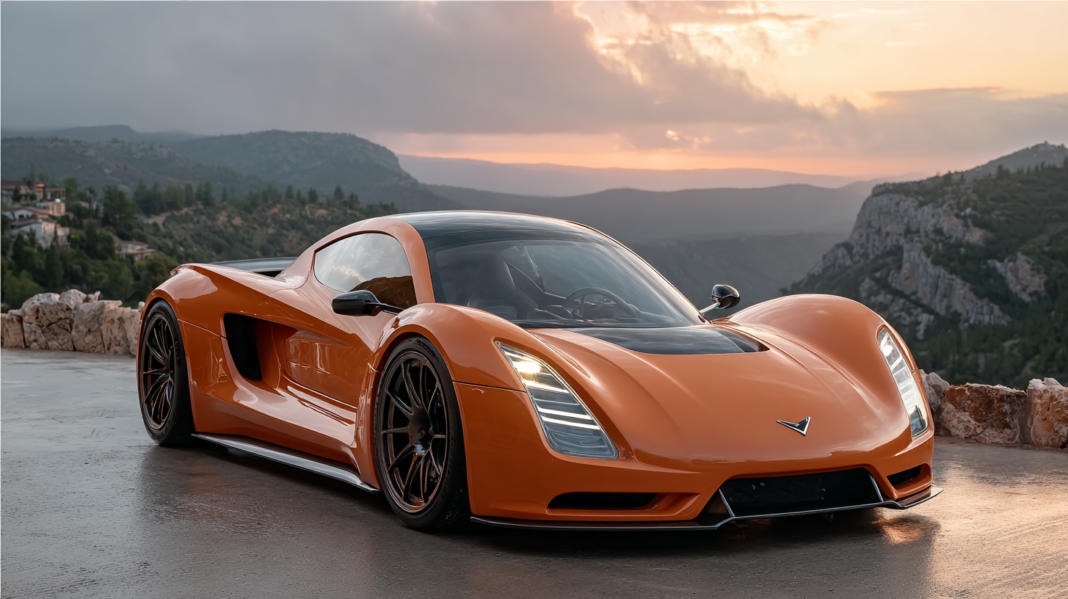
The Czinger 21C is such a machine. Built by a young American company in Los Angeles, the 21C combines a hybrid powertrain producing 1,250 horsepower with a manufacturing process that owes more to aerospace and defense technology than to traditional automotive assembly lines. It uses artificial intelligence to design components, 3D printing to create them, and robotic assembly to fit them together with surgical precision.
As we examine the Czinger 21C in 2026, with production underway and records already broken, this article provides a detailed look at its performance specifications, design philosophy, and what makes this car stand out in the current automotive landscape.
The Czinger Story
Most automakers begin with an idea for a car and then construct a factory to build it. Kevin and Lukas Czinger, the father and son team behind Czinger Vehicles, reversed that sequence. Kevin founded Divergent Technologies with a vision for a new industrial base. The question was not how to build a car but rather how to build things more efficiently, with less weight, less waste, and greater structural integrity.
The answer became the Divergent Adaptive Production System. This platform integrates artificial intelligence design software, proprietary 3D printing technology, and robotic assembly to manufacture complex structures that would be impossible to create using traditional methods. Once the system was proven, the question became what to build to demonstrate its capability.
The answer was the 21C.
Lukas Czinger serves as president and CEO of both Czinger Vehicles and Divergent Technologies. He describes the mission not as building a hypercar, but as creating the industrial base for the twenty first century. The 21C is proof of concept, a rolling demonstration that a new way of manufacturing is not only viable but capable of record setting performance.
Powertrain Specifications
Engine Configuration
The heart of the Czinger 21C is a 2.88 liter twin turbocharged V8 engine designed by Czinger and built in partnership with suppliers. Despite its small displacement, this engine produces 750 horsepower on pump gasoline. With higher octane fuel, output increases to 850 horsepower from the internal combustion side alone.
The engine is remarkable not only for its specific output but for its operating characteristics. It revs to 11,000 rpm, a figure more commonly associated with motorcycle engines or Formula One power units from the early 2000s than with road going V8s. This high revving capability allows the engine to produce power across a broad range while maintaining the compact dimensions necessary to fit within the 21C’s tightly packaged chassis.
Hybrid System
Two electric motors mounted at the front axle contribute an additional 500 horsepower to the total output. These motors operate independently, providing torque vectoring capability that can direct power to the left or right front wheel as conditions demand. This independent control enhances cornering performance by allowing the outside wheel to receive more power during turns.
A third electric motor is integrated with the transmission, handling functions such as starting the engine and recharging the 4.2 kWh battery pack. The battery is relatively small by hybrid standards, reflecting the car’s focus on power delivery and weight management rather than electric only range.
Total Output and Performance
Combined system output reaches 1,250 horsepower. This power is delivered to all four wheels through a transmission mounted at the rear, with the front electric motors providing additional traction when needed.
The performance numbers that result from this powertrain are substantial. The 21C accelerates from 0 to 62 miles per hour in 1.9 seconds. Quarter mile times are not officially published, but the acceleration curve suggests times in the high eight second range at speeds exceeding 160 miles per hour.
Top speed varies by configuration. The V Max variant, optimized for high speed running with a longer tail and reduced drag, reaches 253 miles per hour. More track focused variants trade some top end for increased downforce.
Weight and Power Density
Dry weight is listed at approximately 3,520 pounds. This is not a lightweight figure by traditional sports car standards, but must be considered in context of the hybrid powertrain, all wheel drive system, and the structural requirements of a road legal hypercar.
The resulting power to weight ratio exceeds 780 horsepower per ton, placing the 21C among the most power dense road cars ever produced.
Manufacturing Innovation
Generative Design
The creation of the 21C begins not with a clay model or CAD drawing, but with a set of engineering requirements. Engineers specify the mounting points, the volume a component must occupy, and the structural loads it must withstand. This data is fed into artificial intelligence software that explores millions of potential shapes to find the most material efficient geometry that meets the requirements.
The resulting designs often appear organic, resembling bone structures or natural formations more than traditional automotive components. This is form following function to an unprecedented degree. The AI is not constrained by what a human designer might consider feasible or aesthetically conventional. It optimizes purely for structural performance and weight reduction.
3D Printing
Once the design is finalized, it is manufactured using additive manufacturing techniques. Czinger and Divergent have developed proprietary 3D printers that can produce larger components with greater speed and detail than standard industrial printers.
The printers use laser sintering technology, fusing metal powder layer by layer to build up components. The alloys used are developed in house, formulated to provide the strength necessary for load bearing applications while remaining compatible with the printing process.
Approximately 20 percent of the 21C’s structural components are produced through this method, including suspension uprights, subframes, cooling system channels, and transmission housings. Components that are too large to print as a single piece are bonded together using robotic arms with tolerances down to nearly one twentieth of a millimeter.
Robotic Assembly
The printed components are assembled by robots that position and join them with precision that would be difficult to achieve consistently with human labor. This automated assembly ensures that each 21C meets the same exacting standards, regardless of when it is built or which technician might have worked on it.
The complete process reduces the number of components required for complex assemblies. Where a traditional structure might require 200 individual parts, the 3D printed equivalent can often be produced as four to ten pieces. This reduction in part count simplifies assembly, reduces potential failure points, and contributes to weight savings.
Chassis and Aerodynamics
Carbon Fiber Monocoque
The foundation of the 21C is a carbon fiber tub manufactured by external partners to Czinger’s specifications. This monocoque provides the structural core around which the 3D printed subframes and suspension components are attached.
The tub is designed to meet crash safety standards while maintaining minimal weight. Tolerances are held to standards more typical of aerospace than automotive production.
Suspension System
The suspension uses double wishbone geometry at all four corners, with components manufactured through the additive process. The 3D printed uprights and control arms achieve the necessary strength with minimal material, reducing unsprung mass and improving suspension response.
Electronically adjustable dampers allow the driver to select between drive modes, altering the car’s character from road compliant to track focused. The system can be adjusted through Street, Sport, Track, and Track Plus modes.
Aerodynamic Development
The 21C’s exterior shape is the result of extensive aerodynamic development rather than stylistic whim. Every surface serves a purpose in managing airflow, generating downforce, or cooling the powertrain.
The car’s most distinctive visual feature is its tandem seating arrangement, which places the passenger directly behind the driver rather than beside them. This configuration, inspired by the SR 71 Blackbird spy plane, allows the frontal area to be minimized while still accommodating two occupants. A narrower frontal profile reduces drag and improves aerodynamic efficiency.
The V Max variant, optimized for top speed, features a longer tail section that reduces drag at the expense of some downforce. Track focused variants prioritize downforce for cornering performance, with larger wings and more aggressive aerodynamic elements.
Interior and Driving Position
Tandem Seating
Entering the 21C requires a deliberate sequence of movements. The butterfly doors open upward, and the driver must lower themselves into the narrow cockpit. Once seated, the driver sits centrally, with the passenger positioned directly behind.
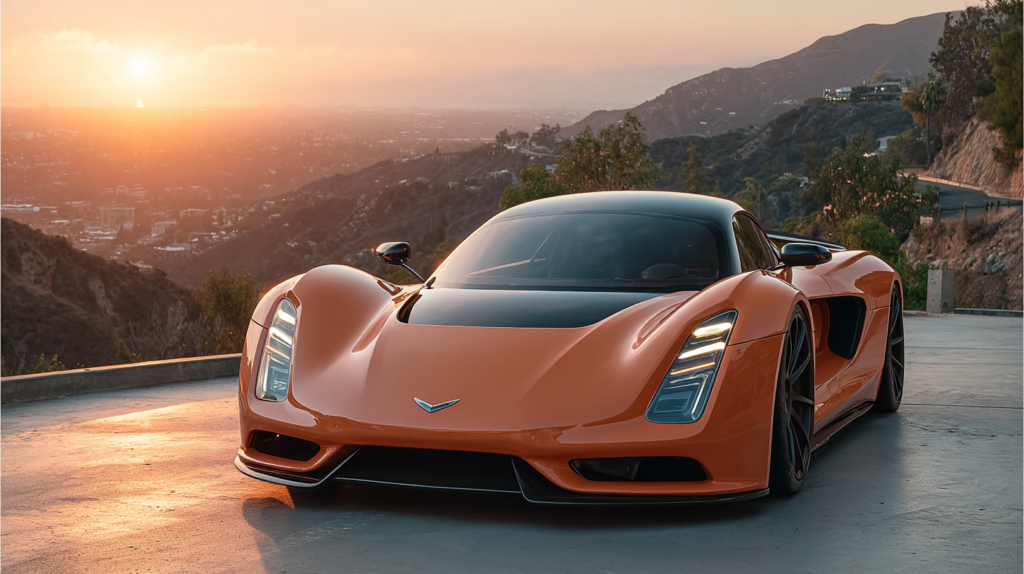
This arrangement provides the driver with an unobstructed view forward, framed by the wheel arches that bulge visibly from the driver’s perspective. The sensation is more reminiscent of a fighter jet than a conventional automobile, which is precisely the effect the designers intended.
Controls and Displays
The steering wheel is octagonal in shape, deviating from the traditional round form. Controls fall readily to hand, with buttons and switches positioned for intuitive operation without requiring the driver to look away from the road.
The instrument display provides essential information in a clear, uncluttered format. Given the car’s performance capabilities, the driver’s attention should remain focused on the road ahead rather than on interpreting complex graphics.
Material Choices
Interior surfaces are finished in materials appropriate to the car’s mission. Carbon fiber appears where structural integrity is required. Alcantara provides grip and reduces glare. There is no pretense of luxury for its own sake. Every material choice serves a functional purpose.
Driving Experience
On Road Character
Driving the 21C on public roads reveals a machine that is surprisingly manageable given its extreme capabilities. The hybrid system allows electric only operation at low speeds, making the car suitable for urban environments without the drama of the V8. In this mode, the 21C is nearly silent, moving with a stealth that contrasts sharply with its visual presence.
When the V8 awakens, the character transforms. The engine spins to 11,000 rpm with a sound that is both mechanical and organic, competing initially with the noise of road particles beneath the car. The ride height in Street mode is approximately 3.6 inches, meaning that every surface irregularity is transmitted to the occupants.
The suspension, while firm, is not punishing. It communicates road conditions clearly without transmitting impacts harshly. The steering provides feedback that allows the driver to place the car precisely, and the brake by wire system modulates stopping force with natural feel despite its electronic intervention.
On Track Performance
On a racetrack, the 21C reveals the full extent of its capability. The combination of all wheel drive traction, active aerodynamics, and the torque vectoring front motors allows the car to accelerate out of corners with authority. Downforce generated at speed presses the car into the pavement, providing grip that mechanical systems alone could not achieve.
The car responds to driver inputs with immediacy. Turn in is sharp, transitions are stable, and power application on exit can be modulated with precision. The driver is connected to the machine in a way that modern electronics often filter out.
Record Setting Performance
To demonstrate the 21C’s capability, Czinger embarked on a tour of California’s premier racetracks. The car was driven on public roads between circuits, covering more than 1,000 miles, and set production car lap records at each location.
The tracks and times included WeatherTech Raceway Laguna Seca, Willow Springs International Raceway, Sonoma Raceway, Thunderhill Raceway Park, and The Thermal Club. At Laguna Seca, the 21C beat the previous record by a significant margin on a circuit where every tenth counts.
Production and Pricing
Manufacturing Location
The 21C is assembled at Czinger’s facility in Torrance, California, an area with deep roots in Southern California’s automotive and aerospace industries. The facility houses the assembly operations where the carbon tub, 3D printed components, and sourced parts come together.
Production Numbers
Czinger plans to build approximately 80 examples of the 21C. This limited production run ensures exclusivity while allowing the company to refine its manufacturing processes and demonstrate the viability of its production system.
Pricing
The base price for the 21C is $2.35 million. This positions it in the upper tier of hypercar pricing, comparable to offerings from established European manufacturers. For this price, buyers receive not only a record setting hypercar but also a piece of manufacturing history.
What Makes the Czinger 21C Stand Out in 2026
The Manufacturing Revolution
In 2026, the most significant aspect of the Czinger 21C is not its performance figures, impressive as they are. It is the method of its creation. The 21C demonstrates that generative design, 3D printing, and robotic assembly can produce a vehicle that competes with and beats the established players on their own terms.
This has implications beyond the hypercar segment. Major automakers are already taking notice of the technology developed for the 21C. The components these companies purchase are manufactured using the same technology developed for the 21C. What begins as a proof of concept in a low volume hypercar can scale to influence mass production.
The hope is that within a decade, this technology will be applied to city cars, producing millions of parts for vehicles that ordinary people can afford. The 21C is not an end in itself. It is a demonstration that a new way of building things is possible.
The Tandem Seating Configuration
The tandem seating arrangement, inspired by the SR 71 Blackbird, distinguishes the 21C from every other hypercar on the market. This is not a styling gimmick but a functional solution to the problem of aerodynamic efficiency. By narrowing the frontal area, Czinger reduces drag while still accommodating a passenger.
The driving experience this configuration creates is unique. The central seating position, combined with the glass canopy and the view forward over the wheel arches, creates a sensation more akin to piloting than driving. It is a deliberate departure from the norm, and it contributes meaningfully to the car’s character.
The American Hypercar
The Czinger 21C is the first American made hypercar to operate in this performance tier with this price point and this level of technological sophistication. While the United States has produced world beating supercars before, none have combined this level of performance with this manufacturing approach.
The 21C demonstrates that American engineering and manufacturing can compete at the absolute pinnacle of the automotive industry. It does so not by copying the formulas established by European manufacturers, but by developing an entirely new approach.
The Sound
At a time when electrification is silencing the automotive world, the 21C’s V8 spinning to 11,000 rpm provides an acoustic experience that is becoming increasingly rare. The sound is not artificially amplified or synthesized. It is the natural product of a small displacement, high revving engine working at the limits of its capability.
For enthusiasts who value the sensory aspects of driving, this sound is a significant part of the car’s appeal. It communicates engine load, rpm, and performance in ways that a digital display cannot replicate.
The Future of Czinger
Focus on the 21C
Czinger has made a strategic decision to focus on the 21C platform rather than expanding its model lineup. Previously announced plans for a grand tourer and an SUV have been shelved indefinitely.
Instead, the company will develop additional variants of the 21C, extending the model’s life into the next decade. These variants could include versions with more traditional side by side seating or even more extreme performance configurations building on the current car’s capabilities.
Technology Licensing
The long term business model for Czinger and Divergent is not dependent on hypercar sales. The real opportunity lies in licensing the production technology to other manufacturers. By demonstrating the system’s capability through the 21C, Czinger provides proof that the technology works at the highest performance levels.
The goal is to eventually produce millions of parts for major automakers. The hypercar serves as a showcase, attracting customers who value cutting edge technology and demonstrating what the system can achieve.
Conclusion
The Czinger 21C represents something rare in the automotive world: a genuine paradigm shift. It is not simply faster or more powerful than its competitors, though it certainly is both. It is built differently, designed differently, and conceived differently from anything that has come before.
The use of generative AI to create organically optimized structures, the 3D printing of load bearing components from proprietary alloys, the robotic assembly with aerospace tolerances these are not incremental improvements to existing methods. They represent a fundamental rethinking of how vehicles can be designed and manufactured.
The performance numbers validate the approach. A 1.9 second zero to sixty time, a 253 mile per hour top speed, lap records at major circuits these are not theoretical capabilities but demonstrated achievements. The 21C does what its creators claim it can do.
Yet the car’s significance extends beyond its own performance. It serves as proof that a new industrial model is viable, that additive manufacturing can produce components strong enough and precise enough for the most demanding applications, and that American ingenuity can still create something that challenges the established order.
For the 80 buyers who will acquire a 21C, the car offers something beyond speed or exclusivity. It offers a glimpse of the future, delivered today. And for the rest of the automotive industry, it offers a challenge: adapt to new methods, or be left behind.
In 2026, the Czinger 21C stands alone. Not because no other car can match its performance, but because no other car is built the way it is built, designed the way it is designed, or conceived the way it is conceived. It is not just a hypercar. It is a declaration that the rules have changed.

