

The pursuit of speed has long been dominated by European manufacturers. Italy, Germany, and the United Kingdom have produced the fastest production cars for generations, with names like Ferrari, Lamborghini, and McLaren defining the upper limits of automotive performance. But in recent years, a new contender has emerged from an unexpected location: Sealy, Texas.
Hennessey Performance Engineering began as a tuning company, modifying cars to extract more power and sharper handling. Over the years, the company grew into a manufacturer in its own right, building the Venom GT, which held the production car speed record for a time. The Venom F5 represents the next step, a car designed from the ground up to be one of the fastest production vehicles in history.
The Venom F5 Revolution, introduced as a track focused variant of the standard F5, takes this pursuit of speed in a different direction. While the standard F5 was designed primarily for top speed runs, the Revolution prioritizes cornering grip, aerodynamic downforce, and sustained track performance. It is a car built for circuits rather than salt flats, a machine that combines Texas engineering with world class performance.
This article provides a detailed examination of the Hennessey Venom F5 Revolution, its performance specifications, design philosophy, and what makes this American speed machine stand out in 2026.
The Hennessey Story
Hennessey Performance Engineering was founded by John Hennessey, a former racer and automotive enthusiast who began modifying cars in the 1990s. The company grew from a small tuning shop into one of the most respected names in high performance automotive engineering. Hennessey’s tuned vehicles, particularly modified Dodge Vipers, established a reputation for extreme power and reliability.
The Venom GT, introduced in 2011, marked Hennessey’s transition from tuner to manufacturer. Built around a lightweight carbon fiber chassis with a twin turbocharged V8 engine producing over 1,200 horsepower, the Venom GT set a production car speed record of 270 miles per hour. It established Hennessey as a legitimate competitor to the established European hypercar manufacturers.
The Venom F5, named for the highest rating on the Fujita tornado scale, represents the culmination of everything Hennessey has learned. It is a clean sheet design, with a carbon fiber monocoque, an aerodynamically optimized body, and a 6.6 liter twin turbocharged V8 engine that produces 1,817 horsepower. The standard F5 was designed with a singular goal: to achieve a top speed of 311 miles per hour, making it the fastest production car in the world.
The Revolution variant takes this platform in a different direction. Rather than chasing the absolute top speed, the Revolution is engineered for track performance, with aerodynamic elements that prioritize downforce over drag reduction.
The Venom F5 Revolution: Track Focused Performance
Design Philosophy
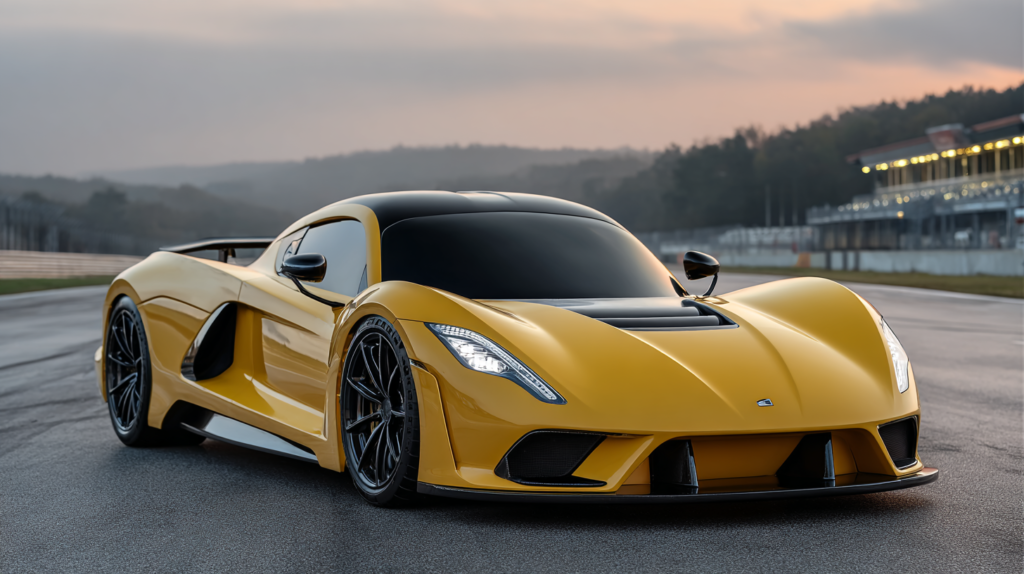
The Revolution shares its basic architecture with the standard Venom F5, but the exterior design is significantly different. Where the standard F5 features a sleek, low drag body optimized for top speed runs, the Revolution adds aerodynamic elements that generate substantial downforce at the expense of some top end velocity.
The most prominent addition is the large fixed rear wing, which replaces the active wing of the standard car. This wing is mounted on two struts and is adjustable, allowing the driver to tailor the downforce balance to suit different tracks and conditions. The wing is constructed from carbon fiber and is designed to provide stable, predictable downforce even at the highest speeds.
The front fascia is also revised, with larger air intakes and a more pronounced splitter that directs airflow under the car. The front wheel arches incorporate vents that reduce pressure buildup in the wheel wells, improving stability and reducing lift. The rear diffuser is more aggressive than the standard car’s, accelerating airflow beneath the vehicle to generate additional downforce.
The body is constructed entirely from carbon fiber, keeping weight to a minimum while providing the structural rigidity required for high speed stability. The Revolution’s dry weight is approximately 3,000 pounds, a remarkable figure for a car with a 1,817 horsepower engine.
Powertrain
The heart of the Revolution is the same 6.6 liter twin turbocharged V8 engine that powers the standard Venom F5. This engine, designed and built by Hennessey, produces 1,817 horsepower at 8,000 rpm and 1,193 lb ft of torque at 5,500 rpm. It is one of the most powerful production engines ever fitted to a road car.
The engine features a bespoke block and cylinder heads, forged internals, and a dry sump lubrication system that allows it to withstand sustained high speed running. The twin turbochargers are mounted in a configuration that minimizes lag while providing the airflow necessary for the engine’s extraordinary output.
Power is transmitted to the rear wheels through a single clutch automated manual transmission developed specifically for the F5. This transmission is designed to handle the engine’s torque while providing rapid, consistent shifts. The gear ratios are optimized for track use, with closer spacing than the standard F5’s ratios to keep the engine in its power band during cornering.
Performance Figures
The Revolution’s performance figures reflect its track focused mission. The car accelerates from 0 to 60 miles per hour in approximately 2.6 seconds. The 0 to 100 miles per hour sprint takes about 4.7 seconds, and 0 to 200 requires approximately 12.5 seconds.
The top speed is reduced compared to the standard F5, with Hennessey quoting a figure of approximately 280 miles per hour for the Revolution. This is a deliberate trade off, with the added downforce of the wing and splitter generating drag that limits the ultimate speed. For track use, this compromise is acceptable; few circuits have straightaways long enough to exceed 200 miles per hour.
The car’s cornering capability is significantly improved over the standard F5. The combination of the aerodynamic downforce, the stiffened suspension, and the wider track allows the Revolution to generate lateral grip that exceeds 1.5 g under ideal conditions.
Chassis and Dynamics
The Revolution shares the carbon fiber monocoque of the standard F5, but the suspension is revised for track duty. The springs are stiffer, the dampers are recalibrated, and the anti roll bars are thicker. The result is a car that responds more directly to steering inputs and maintains better body control through corners.
The suspension is adjustable, allowing the driver to fine tune the car’s behavior to suit different tracks and conditions. The system includes adjustable ride height, spring rates, and damper settings, with the ability to store multiple configurations for different tracks.
The wheels are forged aluminum units sized 19 inches at the front and 20 inches at the rear, wrapped in Michelin Pilot Sport Cup 2R tires that are designed for maximum grip on track surfaces. The tire compound is soft, providing exceptional adhesion at the expense of tread life.
The braking system uses carbon ceramic discs with six piston front calipers and four piston rear calipers. The discs are sized to provide the thermal capacity necessary for sustained track use, with cooling ducts that direct air to the brakes to manage temperatures.
Interior and Driver Experience
Cabin Design
The interior of the Revolution is stripped back compared to the standard F5, with a focus on weight reduction and driver engagement. The seats are carbon fiber racing buckets with minimal padding, upholstered in Alcantara to provide grip during cornering. The seats are fixed in position, with the pedal box adjustable to accommodate drivers of different sizes.
The dashboard is minimalist, with a digital instrument cluster that displays essential information such as speed, rpm, gear position, and lap times. The steering wheel is a flat bottom unit with integrated controls for the car’s systems, allowing the driver to keep their hands on the wheel while adjusting settings.
The cabin lacks many of the amenities found in the standard F5. There is no infotainment screen, no premium audio system, and no sound deadening. The air conditioning is retained, but it is a simplified system designed to provide cooling without adding unnecessary weight.
Driver Controls
The driver interacts with the car through a series of controls designed for use on track. The shift paddles are mounted on the steering column, ensuring they remain in the same position regardless of steering angle. The traction control and stability control systems are adjustable, with settings ranging from full intervention to completely disabled.
A lap timer is integrated into the instrument cluster, with the ability to record sector times and display them in real time. The data acquisition system can log information such as speed, rpm, throttle position, brake pressure, and lateral acceleration, allowing drivers to analyze their performance after each session.
Personalization
Despite its track focus, the Revolution offers a degree of personalization. Buyers can choose from a range of exterior colors and interior trim options, and Hennessey’s team works with each customer to tailor the car to their preferences. The level of personalization is limited compared to the standard F5, reflecting the car’s focus on function over form.
What Makes the Venom F5 Revolution Stand Out in 2026
American Engineering
The Venom F5 Revolution is one of the few hypercars built entirely in the United States. Its engine is designed and assembled in Texas, its chassis is manufactured in North America, and its final assembly takes place at Hennessey’s facility in Sealy. For buyers who value domestic engineering and manufacturing, this is a significant distinction.
The car demonstrates that American engineering can compete at the highest level of the hypercar segment. The 1,817 horsepower output, the 280 mile per hour top speed, the 1.5 g cornering capability these figures place the Revolution alongside the best from Europe.
Track Focus
The Revolution is one of the few hypercars designed specifically for track use. While many manufacturers offer track focused variants, the Revolution’s level of commitment to circuit performance is unusual. The adjustable aerodynamics, the stiffened suspension, the stripped interior all of these elements are chosen to maximize lap times rather than comfort or convenience.
For drivers who plan to use their car on track, this focus is valuable. The Revolution is a tool designed for a specific purpose, and it delivers on that purpose without compromise.
The Engine
The 6.6 liter twin turbocharged V8 is a remarkable piece of engineering. Its 1,817 horsepower output makes it one of the most powerful production engines ever built, and its character is distinct from the V12s and W16s that dominate the hypercar segment. The engine’s sound, its power delivery, and its response are all tuned for the driving experience.
Exclusivity
The Revolution is a limited production model, with only 30 units planned for global production. This rarity ensures that the car will remain a collector’s item, and the track focused configuration distinguishes it from the standard F5.
The allocation of these 30 cars was managed carefully, with priority given to existing Hennessey customers and collectors who have supported the brand. The cars sold out quickly after the announcement, and secondary market values are already reflecting the car’s significance.
The Hennessey Story
The Venom F5 Revolution is part of a larger story: the rise of Hennessey from a small tuning shop to a manufacturer of world class hypercars. For buyers who appreciate this story, the Revolution represents the culmination of decades of engineering passion and entrepreneurial ambition.
Production and Availability
Manufacturing Location
The Venom F5 Revolution is built at Hennessey’s facility in Sealy, Texas, approximately 50 miles west of Houston. This facility has been expanded to accommodate the production of the F5 and its variants, with dedicated assembly areas for the carbon fiber chassis, the engine, and the final assembly.
Production Timeline
Production of the Revolution began in 2025, with the first customer deliveries occurring in early 2026. The production run of 30 units is being completed throughout the year, with each car built to the specifications of its owner.
Pricing
The Venom F5 Revolution carries a starting price of approximately $3.0 million, placing it in the upper tier of hypercar pricing. This figure reflects the car’s exclusivity, its engineering complexity, and its performance capabilities.
Specifications Summary
| Specification | Value |
|---|---|
| Engine | 6.6L twin turbocharged V8 |
| Power | 1,817 horsepower at 8,000 rpm |
| Torque | 1,193 lb ft at 5,500 rpm |
| Transmission | Single clutch automated manual |
| Drive | Rear wheel drive |
| 0-60 mph | 2.6 seconds |
| 0-100 mph | 4.7 seconds |
| 0-200 mph | 12.5 seconds |
| Top Speed | 280 mph (rated) |
| Weight | Approximately 3,000 lb dry |
| Production | 30 units |
| Base Price | $3.0 million |
Conclusion
The Hennessey Venom F5 Revolution represents a significant achievement for American automotive engineering. It is a track focused hypercar that combines a 1,817 horsepower twin turbocharged V8 engine with a lightweight carbon fiber chassis, aggressive aerodynamics, and suspension tuned for circuit performance. It is designed to reward skilled drivers on the world’s most demanding tracks, delivering lap times that compete with the best from Europe.
Yet the Revolution is not defined solely by its specifications. It is defined by the story of its creation: a Texas tuning shop that grew into a manufacturer of world class hypercars, a pursuit of speed that began with modified Vipers and culminated in one of the most powerful production engines ever built.
For the 30 buyers who will acquire a Revolution, it offers something beyond performance. It offers the knowledge that their car was designed and built in the United States, by people who share their passion for speed and engineering excellence. It offers the opportunity to be part of the Hennessey story, a story that continues to unfold.
In 2026, as the automotive industry continues its transition toward electrification, the Revolution stands as a celebration of what internal combustion can still achieve. It is a car that prioritizes driver engagement, that rewards skill and commitment, and that delivers the kind of raw, unfiltered experience that enthusiasts value. It is a Texas built speed machine, and it deserves its place among the world’s most extraordinary hypercars.

