

The idea of a road car powered by a Formula 1 engine has been a dream for enthusiasts since the dawn of the sport. The combination of a screaming V6 hybrid powertrain, advanced aerodynamics, and lightweight construction would, in theory, create the ultimate road going performance machine. But the engineering challenges are immense. Formula 1 engines are designed to be rebuilt after a few thousand kilometers, not to run for years on public roads. They require complex pre heating procedures to start, and they produce emissions that would not pass modern regulations.
The Mercedes-AMG One is the first car to overcome these challenges. Developed over nearly a decade, the One uses a genuine Formula 1 engine derived from the Mercedes AMG F1 W06 hybrid that won the 2015 championship. It combines a 1.6 liter V6 with four electric motors to produce 1,049 horsepower. It is a car that represents the most direct transfer of racing technology to a road car ever attempted.
This article provides a comprehensive review of the Mercedes-AMG One, examining its performance specifications, engineering, design, and what makes it one of the most extraordinary hypercars ever built.
The Genesis: From F1 to Road Car
The Mercedes-AMG One project began in 2016, when Mercedes announced that it would produce a road car powered by a Formula 1 engine. The goal was to create the most technologically advanced road car ever built, a car that would serve as a showcase for the company’s hybrid expertise. The development timeline stretched far beyond the original estimates, as engineers grappled with the challenges of adapting a racing powertrain for road use.
The engine itself is derived from the Mercedes AMG F1 W06 hybrid, a car that won 16 of 19 races in the 2015 season. The road car retains the engine’s fundamental architecture: a 1.6 liter V6 with a 90 degree V angle, a single turbocharger, and a hybrid system that includes both a motor generator unit kinetic and a motor generator unit heat.
The result, after years of development, is a car that is as close to a Formula 1 car as any road legal vehicle has ever come.
Powertrain: The Heart of a Champion
The V6 Engine
The Mercedes-AMG One is powered by a 1.6 liter V6 engine, the same configuration used in Mercedes’ Formula 1 cars. The engine is a 90 degree unit, with a single turbocharger mounted between the cylinder banks in a hot V configuration. It produces 574 horsepower at 9,000 rpm, with a redline of 11,000 rpm.
The engine is not simply a Formula 1 unit dropped into a road car chassis. It has been extensively modified for road use, with a longer lifespan, a revised cooling system, and a new engine management system that allows it to start without the external pre heating that Formula 1 engines require. The engine is designed to last 50,000 kilometers, a figure that is far less than a typical road car but extraordinary for a Formula 1 derived powerplant.
The engine’s sound is unmistakable. At idle, it produces a high pitched whir that is unlike any other road car. At full throttle, it screams to 11,000 rpm with a metallic wail that is pure racing.
The Hybrid System
The One features four electric motors, which together produce 475 horsepower. One motor is integrated into the turbocharger, serving as the MGU H. This motor can spin the turbocharger to eliminate lag, or it can generate electricity from the exhaust gases. The MGU H provides the instantaneous response that characterizes Formula 1 hybrid systems.
A second motor is mounted on the engine crankshaft, serving as the MGU K. This motor provides additional power during acceleration and recovers energy during braking. The remaining two motors are mounted at the front axle, providing all wheel drive and independent torque vectoring.
The electric motors draw power from a lithium ion battery pack, mounted low in the chassis. The battery is designed for power delivery rather than range, with a focus on providing the electric assistance needed for performance. The electric range is approximately 10 miles, sufficient for low speed urban driving.
Total Output
The combined output of the V6 engine and the four electric motors is 1,049 horsepower and approximately 800 lb ft of torque. The power is distributed to all four wheels through an eight speed automated manual transmission.
Performance
Acceleration and Speed
The One accelerates from 0 to 100 kilometers per hour in 2.9 seconds. The 0 to 200 kilometers per hour sprint takes approximately 7.0 seconds. The quarter mile is completed in approximately 9.6 seconds.
Top speed is rated at 352 kilometers per hour, a figure that reflects the car’s aerodynamic development and the capability of its powertrain.
Nürburgring Lap Time
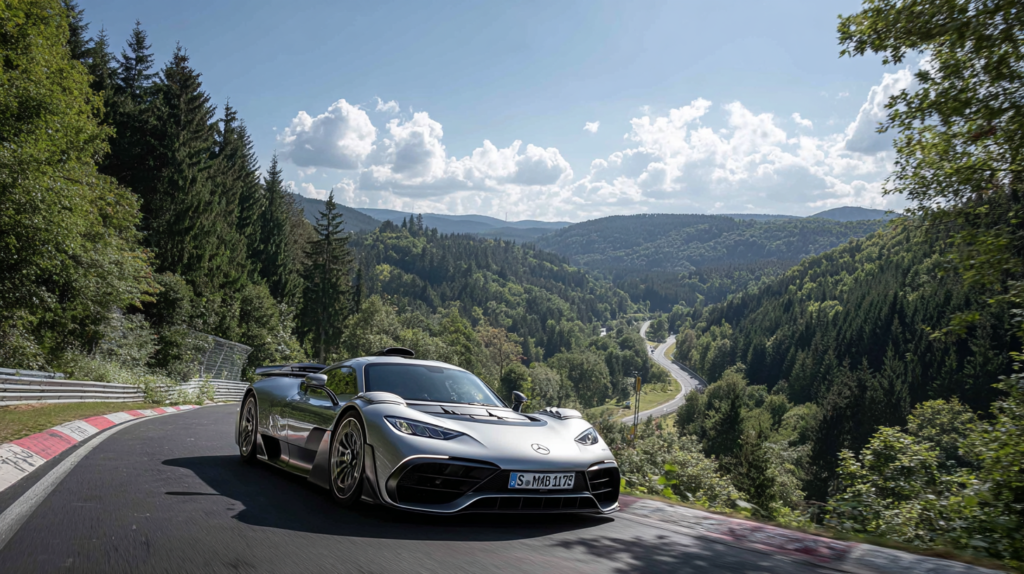
The One set a lap time of 6 minutes 35.183 seconds at the Nürburgring Nordschleife, making it the third fastest production car ever to lap the circuit. The time is remarkable considering the car’s complexity and the challenges of managing its hybrid system over a full lap.
Weight and Balance
The One has a dry weight of approximately 1,695 kilograms. The weight distribution is optimized for handling, with the engine mounted low in the chassis and the battery positioned to maintain a low center of gravity.
Chassis and Dynamics
Chassis Construction
The One is built around a carbon fiber monocoque, providing exceptional rigidity and occupant protection while minimizing weight. The monocoque is manufactured using Formula 1 techniques, with careful attention to fiber orientation and layup sequence.
The suspension is mounted directly to the monocoque, with pushrod actuated dampers at both the front and rear. This configuration, derived from Formula 1, allows for precise control over wheel motion and reduces unsprung weight.
Suspension System
The One features double wishbone suspension at all four corners, with pushrod actuated dampers. The suspension is adjustable, with settings for compression and rebound that can be tuned to suit different tracks and conditions.
The car features an active aerodynamic system that adjusts the front splitter and rear wing to balance downforce and drag. The system is integrated with the car’s electronic controls, adjusting automatically based on speed and driving mode.
Steering
The electric power steering is calibrated for the One’s performance focus. The system provides exceptional feedback, with a level of communication that is rare in electric systems. The steering ratio is quick, requiring minimal input to change direction.
Brakes
The braking system uses carbon ceramic discs with large diameter rotors and multi piston calipers. The system provides exceptional stopping power, with consistent pedal feel and resistance to fade during track use. The regenerative braking system is integrated with the friction brakes, capturing energy during deceleration.
Wheels and Tires
The One rides on 19 inch front wheels and 20 inch rear wheels, wrapped in Michelin Pilot Sport Cup 2 R tires developed specifically for the car. The tire sizes are 285/35 ZR19 front and 335/30 ZR20 rear.
Aerodynamics
Active Aero
The One features an active aerodynamic system that adjusts the car’s downforce based on speed and driving mode. The front splitter has adjustable elements that change the amount of downforce generated. The rear wing is a two element design that can be adjusted for different tracks and conditions.
The system is designed to generate downforce without excessive drag. At top speed, the car generates approximately 800 kilograms of downforce, a figure that places it among the most aerodynamically advanced production cars ever built.
Underbody Aero
The car’s underbody is flat from the front splitter to the rear diffuser, a design that improves airflow and reduces drag. The diffuser is large and complex, with multiple channels that accelerate airflow beneath the car and generate downforce at the rear axle.
Cooling
The One’s cooling system is one of its most complex engineering achievements. The car features 14 separate heat exchangers, including radiators for the engine, electric motors, battery, and transmission. The front end of the car is almost entirely dedicated to cooling, with large grille openings and ducts that direct air to the various heat exchangers.
Interior and Driver Focus
Cabin Design
The interior of the One is stripped back and focused on the driver. The seats are carbon fiber racing buckets with minimal padding, upholstered in Alcantara to provide grip during cornering. The seats are fixed in position, with the pedal box adjustable to accommodate drivers of different sizes.
The dashboard features a digital instrument cluster that can be configured to display performance data, including lap times, g forces, and power distribution. The steering wheel is a flat bottom unit with integrated controls for the car’s systems, including the hybrid modes, driving modes, and audio functions.
The car has no infotainment screen. There is a small display for the audio system and climate controls, but the focus is on driving. The car does have a premium audio system, but it is an afterthought compared to the sound of the engine.
Driving Modes
The One features six driving modes: Race, Race Safe, EV, Individual, and two Race modes that adjust the hybrid system’s behavior. In EV mode, the car can operate on electric power for approximately 10 miles. In Race modes, the hybrid system provides maximum power and energy recovery, with the MGU H spooling the turbocharger to eliminate lag.
Driving Experience
On Road Character
The Mercedes-AMG One is not a car that can be fully appreciated on public roads. Its Formula 1 engine requires a specific warm up procedure, and its stiff suspension transmits every imperfection in the road surface. The car is loud, with the engine’s high pitched whine dominating the cabin at all speeds. It is not comfortable, and it is not quiet.
Yet there is something extraordinary about driving a car with a genuine Formula 1 engine on public roads. The sound, the response, the sense that you are operating a piece of racing history these are experiences that no other car can provide.
On Track Behavior
When driven on a track, the One reveals the depth of its engineering. The car accelerates with a ferocity that is difficult to describe, with the electric motors filling the gaps between gear shifts and the MGU H eliminating turbo lag. The brakes provide consistent stopping power lap after lap, and the chassis remains composed through corners.
The car’s handling is exceptional, with the front axle motors providing torque vectoring that pulls the car into corners and the rear axle providing the power to drive out. The car is balanced and predictable, with a level of feedback that is rare even among dedicated track cars.
The Sound
The One’s engine sound is unlike any other road car. At low speeds, it produces a high pitched whir that is almost musical. At full throttle, it screams to 11,000 rpm with a metallic wail that is pure racing. The sound is not loud in the traditional sense, but it is intense, immediate, and deeply engaging.
Rarity and Exclusivity
Production Numbers
Mercedes-AMG built 275 units of the One, all of which were sold before production began. The cars were allocated to a select group of customers, many of whom were existing Mercedes collectors or Formula 1 enthusiasts.
Pricing
The One carried a base price of approximately $2.7 million, with final prices varying based on options and personalization. For context, the Porsche 918 Spyder was priced at approximately $850,000, and the Ferrari LaFerrari was priced at approximately $1.4 million.
Collector Value
The One’s limited production numbers, its Formula 1 derived powertrain, and its status as the most technologically advanced road car ever built have made it a highly desirable collector car. Values on the secondary market have appreciated significantly since production ended.
Specifications Summary
| Specification | Value |
|---|---|
| Engine | 1.6L V6 hybrid |
| Engine Power | 574 hp at 9,000 rpm |
| Electric Motor Power | 475 hp |
| Combined Power | 1,049 hp |
| Redline | 11,000 rpm |
| Transmission | 8 speed automated manual |
| Drive | All wheel drive |
| 0-100 km/h | 2.9 seconds |
| 0-200 km/h | 7.0 seconds |
| Top Speed | 352 km/h |
| Downforce | 800 kg |
| Weight | 1,695 kg dry |
| Nürburgring Lap Time | 6:35.183 |
| Production | 275 units |
| Base Price | $2.7 million |
Conclusion
The Mercedes-AMG One represents an extraordinary achievement in automotive engineering. It is the first road car powered by a genuine Formula 1 engine, a machine that combines a 1.6 liter V6 hybrid powertrain with advanced aerodynamics and lightweight construction. It is a car that set a lap time of 6 minutes 35 seconds at the Nürburgring, making it one of the fastest production cars ever to lap the circuit.
The One is not a car for everyone. Its development cost is immense, its production is limited to 275 units, and its price is beyond the reach of all but a few. It is not comfortable, not quiet, and not practical. But it is a car that represents the absolute pinnacle of what is possible when engineers are given the freedom to create without compromise.
For the 275 owners who acquired a One, the car offers something that no other vehicle can provide: the experience of driving a genuine Formula 1 car on public roads. It is a car that honors Mercedes’ racing heritage, and it stands as one of the most extraordinary hypercars ever built.

