
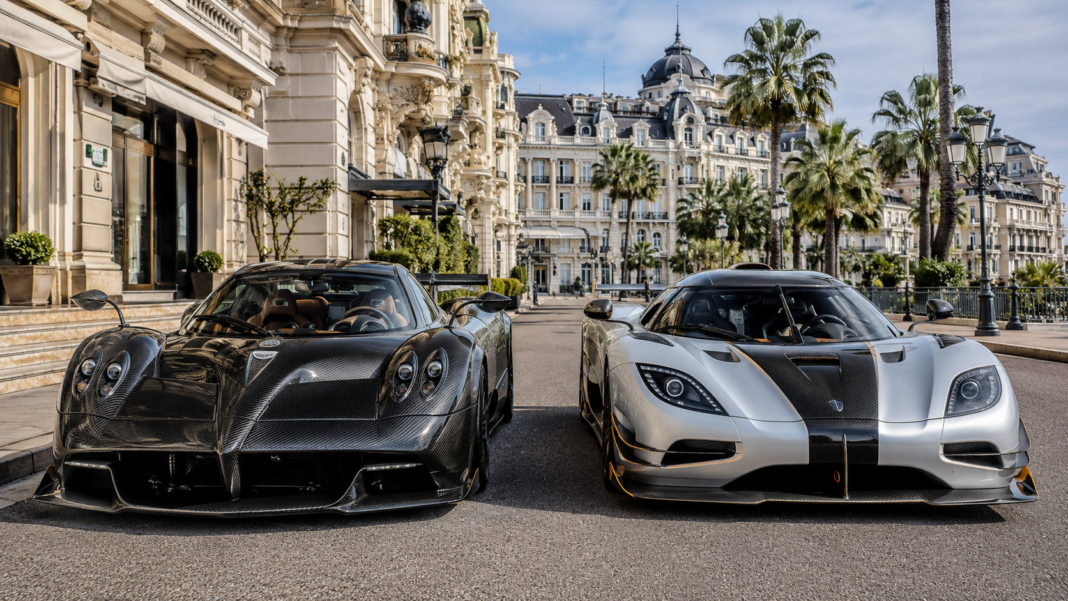
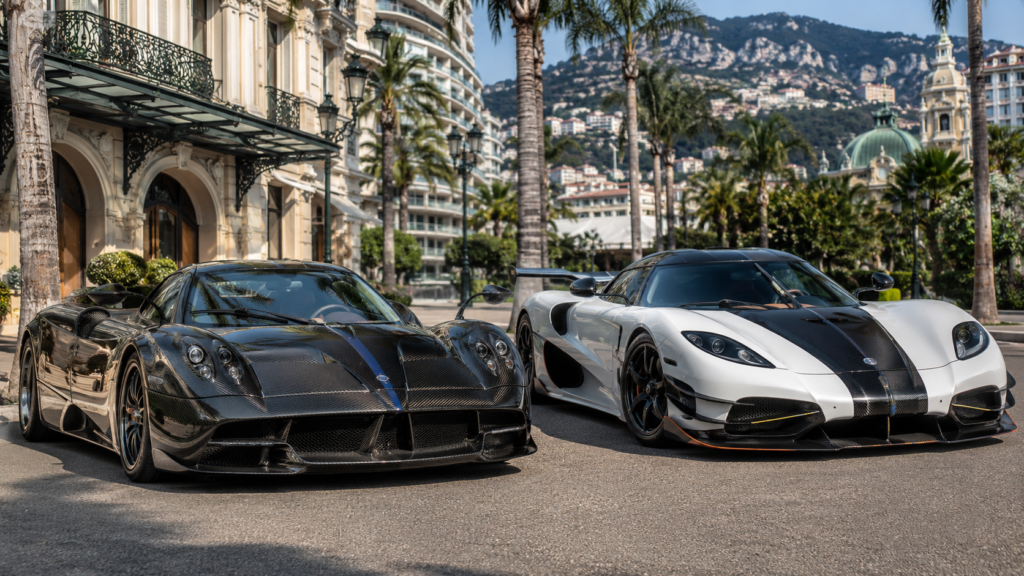
The sun hangs low over the Mediterranean, casting a golden glow across the harbor of Monte Carlo. Yachts worth hundreds of millions of euros bob gently in the water. The streets are quiet this early in the evening, the casino not yet alive with the clatter of chips and the murmur of high rollers. Into this quiet comes a sound like thunder rolling off the cliffs. It is the bark of a twin turbo V12, the unmistakable signature of a Pagani Huayra. Moments later, a sharper, more mechanical whine joins the chorus. It is the scream of a twin turbo V8 from a Koenigsegg Agera RS. Two of the most extraordinary hypercars ever built have arrived on the same stretch of asphalt.
The Pagani Huayra and the Koenigsegg Agera RS represent two very different visions of the hypercar. Both are hand built in limited numbers. Both cost millions of dollars. Both are capable of speeds that would have been unthinkable a generation ago. But they approach the problem of performance from completely different angles. The Huayra is a work of art, sculpted by artisans who treat carbon fiber like clay. The Agera RS is an engineering tour de force, a machine designed to push the boundaries of physics.
This article compares the Pagani Huayra and the Koenigsegg Agera RS across performance, engineering, design, driving experience, and legacy to determine which represents the greater engineering achievement.
The Contenders: Two Different Philosophies
Pagani Huayra
The Huayra is the second model from Pagani, following the Zonda. It is named after Huayra Tata, the Incan god of wind. The car is powered by a 6.0 liter twin turbo V12 engine developed by Mercedes AMG. It produces 720 to 789 horsepower depending on the variant. The Huayra is famous for its active aerodynamics, with four movable flaps that adjust to balance downforce and drag.
Koenigsegg Agera RS
The Agera RS is a limited production variant of the Agera, which followed the CCX. It is named after the Swedish verb “to act,” reflecting the company’s focus on action rather than appearance. The car is powered by a 5.0 liter twin turbo V8 engine developed in house. It produces 1,160 to 1,341 horsepower depending on the fuel used. The Agera RS is famous for its power to weight ratio and its record setting top speed.
Performance: The Numbers That Define an Era
Pagani Huayra
The Huayra’s Mercedes AMG V12 is a masterpiece of forced induction. The twin turbos provide strong low end torque, and the engine pulls to its 6,700 rpm redline.
- Engine: 6.0L twin turbo V12
- Horsepower: 720 to 789 hp
- Torque: 738 to 811 lb-ft
- Transmission: 7 speed automated manual
- Drive: Rear wheel drive
- 0 to 60 mph: 3.2 seconds
- Top Speed: 230 to 238 mph
- Weight: 1,350 kg dry
Koenigsegg Agera RS
The Agera RS’s V8 is a powerhouse. On E85 fuel, it produces up to 1,341 horsepower. The power to weight ratio is exceptional, making the car incredibly quick.
- Engine: 5.0L twin turbo V8
- Horsepower: 1,160 to 1,341 hp
- Torque: 1,100 lb-ft
- Transmission: 7 speed dual clutch
- Drive: Rear wheel drive
- 0 to 60 mph: 2.8 seconds
- Top Speed: 278 mph (record)
- Weight: 1,295 kg dry
Performance Verdict
The Koenigsegg Agera RS is the more powerful and faster car. Its 1,341 horsepower is significantly more than the Huayra’s 789. The Agera RS holds the world record for the fastest production car, with a two way average speed of 277.9 mph. The Huayra is fast, but it is not in the same league as the Koenigsegg.
Engineering: Two Paths to Speed
Pagani Huayra: Active Aerodynamics
The Huayra’s most distinctive engineering feature is its active aerodynamic system. Four flaps, two at the front and two at the rear, adjust their angle based on speed, steering angle, and braking. The system provides downforce when needed for cornering and reduces drag for straight line speed. The flaps move continuously, keeping the car balanced in all conditions.
The Huayra also features a carbon titanium monocoque, a hybrid material that combines carbon fiber with titanium. The structure is lightweight and incredibly rigid. The suspension uses double wishbones at all four corners, with pushrod actuated dampers.
Koenigsegg Agera RS: Lightweight Power
The Agera RS’s engineering focus is on power to weight. The 5.0 liter V8 is one of the most powerful production engines ever built. The engine features a flat plane crankshaft, titanium connecting rods, and a carbon fiber intake manifold.
The Agera RS also features a carbon fiber monocoque with honeycomb aluminum core. The suspension uses double wishbones at all four corners, with pushrod actuated dampers. The car also features a removable hardtop, allowing it to be driven as a coupe or a targa.
Engineering Verdict
Both cars are engineering masterpieces. The Huayra’s active aerodynamic system is more advanced and complex. The Agera RS’s powertrain is more powerful. The Huayra is perhaps the more clever engineering achievement, while the Agera RS is the more brutal.
Design: Art vs Science
Pagani Huayra: Sculpted Beauty
The Huayra’s design is breathtaking. The body is sculpted and organic, with flowing lines that catch the light. The front end features a prominent grille and signature quad headlights. The side profile shows the dramatic side air intakes and the curved roofline. The rear end is dominated by the four exhaust outlets and the active flaps.
The interior is a work of art. The materials are exceptional, with leather, carbon fiber, and machined aluminum throughout. The controls are arranged like an aircraft cockpit. The seats are comfortable and supportive.
Koenigsegg Agera RS: Functional Aggression
The Agera RS’s design is more functional. The body is smooth and aerodynamic, with a focus on reducing drag. The front end features a small grille and slim headlights. The side profile shows the large side air intakes and the distinctive removable roof. The rear end features a large diffuser and dual exhaust outlets.
The interior is more spartan than the Huayra. The materials are high quality, but the focus is on function over luxury. The seats are supportive, and the controls are simple and intuitive.
Design Verdict
The Pagani Huayra is the more beautiful car. It is a rolling sculpture, a work of art that happens to be a hypercar. The Koenigsegg Agera RS is more functional, but it lacks the Huayra’s emotional appeal.
Driving Experience
Pagani Huayra: The Ballet
The Huayra is a car that rewards finesse. The engine is responsive, but the power comes on smoothly. The active aerodynamics keep the car planted, allowing the driver to carry speed through corners. The steering is precise and communicative. The Huayra feels alive, dancing on the road.
Koenigsegg Agera RS: The Bludgeon
The Agera RS is a car that demands respect. The power is immense, and it comes on aggressively. The car requires smooth inputs; any sudden throttle application can overwhelm the rear tires. The steering is direct but less communicative than the Huayra’s. The Agera RS feels like a weapon, a tool for conquering roads and records.
Driving Verdict
The Huayra is the more enjoyable car to drive at normal speeds. It is engaging and communicative. The Agera RS is the more thrilling car at the limit, but it is also more demanding and less forgiving.
The Monte Carlo Drive
Back on the streets of Monte Carlo, the two hypercars approach the iconic hairpin of the Grand Prix circuit. The Huayra goes first. The active flaps adjust, the suspension compresses, and the car rotates neatly around the tight corner. The driver shifts manually, the automated gearbox delivering a crisp change.
The Agera RS follows. The power is intoxicating, but the driver must be careful. Too much throttle and the rear end will step out. The car is a handful, even at low speeds. The driver manages it with skill and concentration.
The two cars park side by side near the casino. Onlookers gather, phones raised. The Huayra draws gasps of appreciation. The Agera RS draws stares of awe.
Legacy and Value
Pagani Huayra
The Huayra was produced from 2011 to 2018. Approximately 100 coupes were built, along with the Huayra Roadster, BC, and Imola variants. Prices started at approximately $1.5 million. Today, Huayras trade for $2 to $3 million depending on the variant.
Koenigsegg Agera RS
The Agera RS was produced from 2015 to 2018. Only 25 units were built. The car that set the world speed record sold for approximately $2.5 million. Today, Agera RS models trade for $3 to $5 million depending on provenance.
Value Verdict
Both cars have appreciated significantly. The Agera RS’s record setting pedigree makes it the more valuable collector car. The Huayra’s artistry and beauty make it the more desirable to many enthusiasts.
Which Is the Greater Engineering Achievement?
The answer depends on how you define engineering.
If you define engineering as the pursuit of absolute performance, the Koenigsegg Agera RS is the greater achievement. Its power to weight ratio, its top speed record, and its raw performance numbers are unmatched. It is a car that pushes the boundaries of what is physically possible.
If you define engineering as the integration of art and technology, the Pagani Huayra is the greater achievement. Its active aerodynamics, its carbon titanium monocoque, and its breathtaking design represent a level of craftsmanship and innovation that is rare in any field.
Both are extraordinary. Both are masterpieces. The Huayra is the work of an artist who happens to be an engineer. The Agera RS is the work of an engineer who happens to create art.
The Final Verdict
The Pagani Huayra and the Koenigsegg Agera RS are two of the greatest hypercars ever built. They approach the same problem from completely different angles. The Huayra is about beauty, engagement, and the joy of driving. The Agera RS is about power, speed, and the thrill of conquest.
Which one is right for you? If you want a car that you can drive on a winding road and feel like a part of the scenery, choose the Huayra. If you want a car that you can take to a racetrack or a salt flat and set records, choose the Agera RS.
As the sun sets over Monte Carlo, the two hypercars disappear into the night. The Huayra’s V12 rumbles, then fades. The Agera RS’s V8 screams, then quiets. They are gone, but they are not forgotten. They are legends.
Specifications Summary
| Specification | Pagani Huayra | Koenigsegg Agera RS |
|---|---|---|
| Engine | 6.0L twin turbo V12 | 5.0L twin turbo V8 |
| Horsepower | 720 to 789 hp | 1,160 to 1,341 hp |
| Torque | 738 to 811 lb-ft | 1,100 lb-ft |
| Transmission | 7 speed automated manual | 7 speed dual clutch |
| 0 to 60 mph | 3.2 seconds | 2.8 seconds |
| Top Speed | 230 to 238 mph | 278 mph (record) |
| Weight | 1,350 kg dry | 1,295 kg dry |
| Production | Approximately 100 coupes | 25 units |
| Base Price | $1.5 million | $2.5 million |
Conclusion
The Pagani Huayra and the Koenigsegg Agera RS are two of the most remarkable hypercars ever created. They represent the pinnacle of boutique automotive engineering. The Huayra is a work of art, a machine that prioritizes beauty and engagement. The Agera RS is a record breaker, a machine that prioritizes speed and power.
Neither is objectively better. They are different. The Huayra is for those who want to savor the drive. The Agera RS is for those who want to conquer the road.
Both are legends. Both will be remembered. The choice is yours.

