
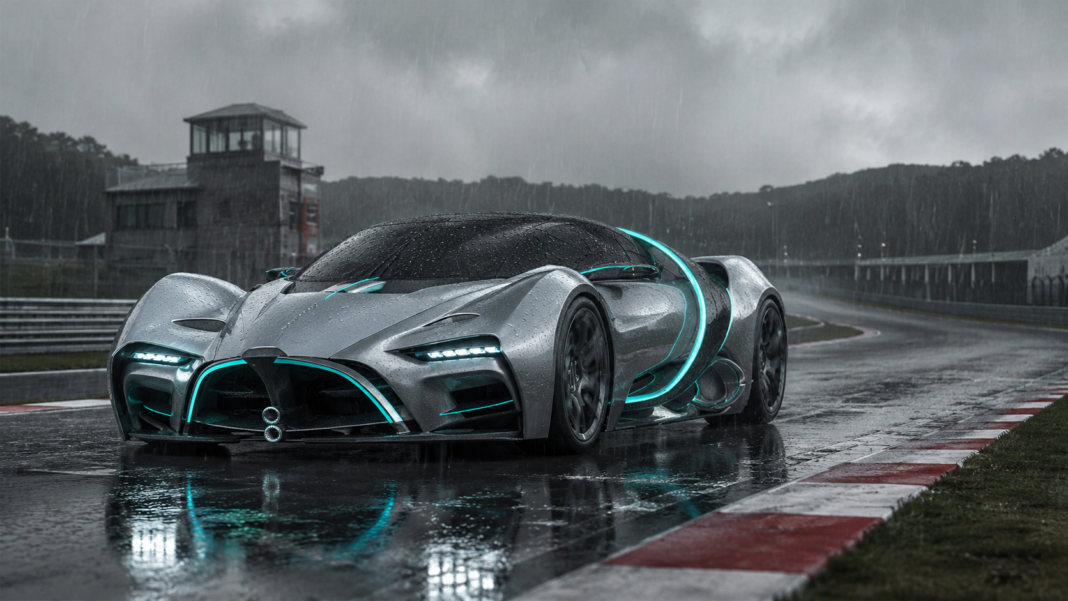
The sun is setting over the hills of western Pennsylvania as a prototype rolls quietly through the paddock at the Pittsburgh International Race Complex in Wampum. The air is thick and humid, a reminder that a heat dome is settling over the eastern half of the country. But the engineers are focused on the car, not the weather. It is a test mule, wrapped in camouflage, hiding a powertrain that does not yet have a name. It is a preview of the future, a glimpse of what a million-dollar hypercar will look like in 2030.
The hypercar market is evolving rapidly. By 2030, a million-dollar hypercar will look very different from today’s models. The powertrain technology will be hybridized, the chassis will be lighter and stronger, and the experience will be more immersive than ever. This article examines the performance targets, powertrain technology, and design directions that will define the next generation of hypercars.
The Hameedi Venturo Project Origine: Redefining the Hypercar
One of the most ambitious projects targeting 2030 is the Hameedi Venturo Project Origine, an all-terrain hypercar developed in Italy with first deliveries targeted for that year. Project Origine is not an SUV or crossover. It is a low, wide, purpose-built performance machine designed to operate across varying conditions without changing its fundamental character.
The car is built around a load-fused carbon and aluminum primary structure, engineered so that suspension and impact loads are sacrificed upstream of the carbon core, protecting the chassis and preserving repairability. The core of the car is an all-new naturally aspirated V12 engine, chosen for its linear response and acoustic character. The engine is designed to deliver smooth, predictable power and a distinct mechanical sound without electrification. The approach to luxury is different: rather than isolating occupants, the car emphasizes clarity, control, and engagement.
Project Origine is built “backwards,” starting with the suspension rather than styling sketches. The suspension architecture defines the platform, with structural layout, packaging, and driveline decisions made in service of kinematic and dynamic objectives. This allows for significant ride-height adjustment while maintaining the proportions, steering feel, and dynamics expected of a performance car.
The Lynx GT1: A Modern Resurrection
Lynx Motors is reviving the first-generation Ford GT platform to create the GT1, a street-legal hypercar with a supercharged V8 producing over 1,200 horsepower. Only 28 units are expected to be built, with each potentially costing over $1 million. The car features a six-speed manual transmission and a carbon fiber body.
The project demonstrates that the million-dollar hypercar of 2030 will not be limited to new platforms. Manufacturers will continue to find value in iconic designs, updating them with modern powertrains and materials.
The Alpine Alpenglow Hy6: Hydrogen Performance
Alpine, the French performance brand, has developed the Alpenglow Hy6, a rolling prototype that runs on a 3.5-liter twin-turbo V6 engine fueled by hydrogen. The engine produces 740 horsepower and revs to 9,000 rpm. The car can exceed 330 km/h, and its exhaust emits only water.
The engine was developed entirely in-house at Alpine’s Viry-Châtillon facility, taking two years of work. It uses a 100-degree V6 with two turbochargers, a solid aluminum engine block with a dry sump, and chain-driven overhead camshafts. The engine’s specific power places it among the most efficient high-performance engines ever built. Fuel is stored in three high-pressure hydrogen tanks, located in the sidepods and behind the cockpit.
Alpine is pushing for hydrogen-powered cars to be authorized to compete at the 24 Hours of Le Mans from 2028 onward, positioning itself to be ready for a future where hydrogen and combustion can coexist.
The Fast F61H V12: Hydrogen Meets Italian Design
The startup Fast Auto has unveiled the F61H, a hydrogen-powered V12 supercar designed by Ken Okuyama, the renowned designer behind the Ferrari Enzo and Maserati Quattroporte. It produces around 500 horsepower and emits only water vapor. Fast Auto is accepting orders, with first production models scheduled for the coming months.
The car draws lineage from the Pininfarina Birdcage concept, a collaborative project that embodied futuristic sports design. Co-founder Ken Okuyama stated that while the F61H might look like a beautiful supercar, what is inside is a hydrogen-powered internal combustion engine, offering the same excitement in sound and performance while only water comes out of the exhaust.
The Hyperion XP-1: Fuel Cell Power
The Hyperion XP-1 is an American hydrogen fuel cell supercar that produces over 2,000 horsepower from four electric motors, accelerates to 100 km/h in less than 2.2 seconds, and has a claimed range exceeding 1,000 kilometers. The car uses supercapacitors instead of conventional lithium-ion batteries and can be refueled in 3 to 5 minutes. It represents the alternative path for hydrogen: fuel cells that convert hydrogen to electricity, rather than burning it directly.
The 2030 Motorsport Connection
The 2030 hypercar market will be influenced by developments in motorsport. The FIA, ACO, and IMSA have announced a unified set of technical regulations for the Hypercar class in the World Endurance Championship, effective in 2030. The new rules call for common chassis rules, the elimination of four-wheel drive cars, and options for manufacturers to build bespoke chassis and hybrid systems.
The 24 Hours of Le Mans will accommodate hydrogen vehicles in competition from 2030, with prototypes using combustion engines fueled by liquid hydrogen. This will provide a testing ground for hydrogen technology that could eventually reach road cars. Porsche, which withdrew from the Hypercar class at the end of 2025, has described the move to a single set of regulations as a “significant step” and has not ruled out a return in 2030.
The Pittsburgh Evening
The sun has fully set over the Pittsburgh International Race Complex. The test mule has completed its session. The data collected will inform the development of a hypercar that will debut in 2030.
The million-dollar hypercar of 2030 will be hybridized, lightweight, and highly personalized. It will use advanced materials like carbon fiber and aluminum in load-bearing structures. It will be influenced by developments in motorsport. It will be a machine that combines extreme performance with sustainability.
The Hameedi Venturo Project Origine, the Lynx GT1, the Alpine Alpenglow Hy6, and the Hyperion XP-1 all point to a future in which hypercars are more capable, more exclusive, and more connected to the world of motorsport and emerging technologies like hydrogen.
Key Takeaways
- Hameedi Venturo’s Project Origine is an all-terrain hypercar with a naturally aspirated V12, targeting 2030 delivery.
- Lynx Motors is reviving the first-generation Ford GT platform with a 1,200+ hp supercharged V8 and a six-speed manual transmission.
- Alpine’s Alpenglow Hy6 is a hydrogen combustion hypercar with a 740 hp V6, revving to 9,000 rpm and emitting only water.
- Fast Auto’s F61H V12 is a hydrogen-powered supercar designed by Ken Okuyama, accepting orders for production.
- The Hyperion XP-1 is a hydrogen fuel cell hypercar with over 2,000 horsepower and a range exceeding 1,000 kilometers.
- The 2030 WEC regulations will unify the Hypercar class and allow hydrogen vehicles at Le Mans.
Conclusion
The hypercar of 2030 will be a different machine from the hypercar of today. It will be hybridized, lightweight, and highly personalized. It will use advanced materials and emerging technologies. It will be influenced by developments in motorsport. It will be a machine that combines extreme performance with sustainability.
The test mule is gone. The Pittsburgh track is quiet. But the future is clear. The million-dollar hypercar of 2030 will be faster, more capable, and more exclusive than anything that has come before. It will be a machine that defines the next era of automotive performance.

